

|
ireland
the earth-mother's
|
|
IRISH PREHISTORIC
ARCHITECTURE

Maps or magic ?
|
|
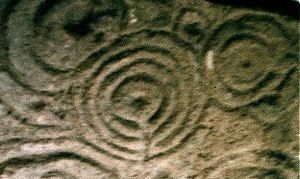
These petroglyphs or rock-scribings (or rock-art) , generally assigned to the Bronze Age, may share at least some functions and concerns with the art of the Neolithic passage-tombs. They may be purely derivative, or they may represent an independent (though obviously related) tradition of lithomancy. Their distribution around the coastline at different altitudes recalls the littoral origin of passage-tombs, and their function is perhaps more mysterious, if less varied.
While littoral rock-scribings on La Palma in the Canary Islands are very similar to Breton and Irish passage-tomb designs (particularly those at Sess Kilgreen in Tyrone), they and the Irish petroglyphs are very different from the petroglyphs of southern Sweden and Norway representing ithyphallic hunters, game, sun-wheels and boats (see right) . Some of the Irish and British petroglyphs more resemble pictographs such as the traffic-signs and concourse-notices that occur everywhere today. They are also unrelated to the crude criss-cross patterns found very occasionally at or in court-, portal- and wedge-tombs...
...and, in one instance, on a rock face.
But they are obviously related to the cup-marks which evolved from natural solution-pits in rock and boulders, and which were sometimes enhanced by surrounding rings.
They are never extensive like some in Argyll which cover up to 1800 square metres. Like the other Atlantic petroglyphs they are mostly on horizontal outcrops or on table-like surfaces of boulders.
And like the far more numerous stone circles , they are nearly always carved where there is a panorama or a wide open view.
One exception occurs in county Kerry, which has the highest concentration of Irish petroglyphs.
Another occurs in the other county of high petroglyphic concentration: Donegal.
They also occur on the vertical surfaces of standing-stones which are the principal or marker stones of alignments.
But petroglyphs are not obviously"cultic" like the relatively easy-to-interpret stones of the Iron Age - of which our culture is a hugely-enhanced extension.
The most frequent motif is the cup-and-ring, or cup and partial ring (sometimes with a tail which always points downwards) and surfaces with this motif tend to occur near places where copper or gold ores were mined. Hence the possibility that they are priestly-prospectors' maps or signposts. (A famous carved rock face at Valcamonica in N Lombardy - nowhere near the sea - is thought to be a map showing buildings, streams, paths and fields.) One site at least has sun-viewing significance twice a year, so this also must be reckoned with.
Other petroglyphic motifs, such as the multiple concentric ring and the multiple concentric lozenge which occur frequently in passage-tombs, have been found on the lower surfaces of the covers of kist-tombs - which sometimes have come from elsewhere and re-used or adapted for funerary use.
Certainly they had a 'mystic' and 'ritual' significance which fitted in with funeral rites, early astronomy and metal-mining. They are also part of a common Atlantic seaboard (or edge-of-the-known-world) culture which persists today in the striking similarities of character in people inhabiting a littoral line passing from Norway around Scotland and Ireland, across to Cornwall and over to Brittany, across the Bay of Biscay to Asturias and Portugalicia, and on to the Canary Islands off the Moroccan coast. Petroglyphs of probably-similar date also occur at least as far south as Gabon.
But their interest lies mainly in their appeal and surprise to the eye. In an island where you might have to drive at least ten miles to find something beautiful made by man (unlike many parts of rural Europe where you have to drive at least ten miles to find an ugly building), petroglyphic rocks and stones are especially delightful - even if, like this one, it has been irreverently dumped at the edge of a field.
|




|
back to
|
The photos and text of these pages are anti-copyright by
Anthony Weir, whose
EARLY IRELAND: A FIELD GUIDE
was published in 1980, quickly sold out,
and was never reprinted.


|
|

or
|
|
Click on the thumbnails for high-resolution pictures.

Tanum, southern Sweden.