

|
ireland
the earth-mother's
|
|
IRISH PREHISTORIC
ARCHITECTURE

ending Prehistory. .
|

|
Stone forts or cashels (Irish caiséal from Latin castellum ) are the monuments of the Iron-age, now Celtic-speaking, inhabitants of Ireland. The introduction of iron weapons and the structural changes of society evidently led to a great increase in cattle-raising, hence cattle-raiding and warfare - for cattle were the real unit and source of wealth. Even today it is cattle that the Irish love, not the land they overgraze. Gradually, people would have had less time, inclination and opportunity to erect even simple stone kists - because they were building fortified, kraal -like farmsteads and refuges which, in rocky, treeless areas, or when built by the powerful, were of stone.
Grianán of Ailech, county Donegal Their dating is difficult, but most of those that survive were built well after the first century BC. Many were built or kept in service right into the mediæval period. They assume various forms, the simplest being the Promontory-forts which are stone walls across the necks of coastal promontories on which other defences and buildings might be constructed in wood and/or stone. Inland promontory-forts cut off mountain-spurs in a similar fashion.
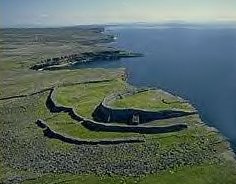
Dunbeg promontory-fort, county Kerry More sophisticated ones do not actually cut off a promontory but occupy a cliff-top higher than the surrounding ground, as at Dún Aonghasa on the Aran Islands. This fort has a chevaux-de-frise of thousands of stone obstacles as a further protection against attack
Dún Aonghasa, Inishmore, county Galway - with surrounding chevaux-de-frise The cashels proper, or (mostly) circular stone-walled forts, could be very large and complex structures covering up to a hectare or more. These occupied already-defensible positions. Several survive in the Burren of county Clare, and in the maritime counties from Cork clockwise to Antrim. Many have wall-chambers, stone staircases and terraces, as well as remains of round huts. Most of these were, unfortunately, over-restored by fanciful engineers towards the end of the nineteenth century, and should be admired with a little scepticism.
Dún Conor, Inishmaan, county Galway At least one (over-restored) stone fort is on an artificial island in a lake.
Doon Fort, county Donegal Such artificial islands - known as Crannógs (from crann = tree, timber, wood) - occur in their thousands all over Ireland, but rarely bore anything so massive as a cashel. Mostly they were built with brushwood and branches weighted with stones, and defensible corrals were constructed so that cattle could be driven over and protected during unsettled (that is to say most) times right up to the late mediæval period. They are not large and would have been refuges for just one extended family and its cattle.
A fisherman at Lough-na-Cranagh on top of Fair Head, county Antrim
Associated with stone forts, but also occurring in huge numbers all over the maritime counties, are Souterrains or underground passages which served as places of safe storage of foodstuffs and valuables, of refuge, and secret means of entering and leaving defended places, particularly during the period of Viking/Norse raids in the ninth and tenth centuries - though some were built (and destroyed) as late as the thirteenth century. They can be simple passages, sometimes roofed with suitable and convenient standing-stones or ogam-stones , or they can be complex labyrinths with defensible 'creeps' or stile-like obstacles. Thousands must have been mere underground tunnels. Several souterrains were dug into the passage-tomb at Knowth, and one can still be seen at Dowth, county Meath.
Exposed souterrain revealing roof-lintels.
|




|
<< Petroglyphs
|
This page is also on the

which is a greatly-expanded version of this website, with many more photographs.

Click on the thumbnails for high-resolution pictures.