
|
|
Potency and Sin:
Ireland and the
Phallic Continuum
Anthony Weir

One of the deepest absurdities in our culture is the unacknowledgement of sexual symbolism - not only in everyday life, but also in art and art history. Yet every country, every culture, has a great and common stock of examples of phallic, testicular, vulvular or mammary objects, since we (especially males) are fascinated not only by the places of pleasure in the opposite sex, but also by our own.
The penetrating psychological insights of Jung and Freud have demonstrated that the phallus is a powerful and polyvalent symbol of power, productivity, dynasty, violence, creativity, potency, filthiness, lust, strength, receptitude, threat, 'The Big Stick', apotropy, endurance, the self, etc. Jung also pointed out that universal symbols like the phallus have a way of surfacing willy-nilly, whether in dreams, fantasies, repugnance, or in artefacts. The choicest example of the latter occurred in Victorian Britain. At a time when tables were heavily draped lest anyone see their groins, when the most savage interdictions (some still surviving) were imposed on anything connected with natural sexual curiosity, Victorian tables were adorned with the most outrageously phallic salt and pepper pots. Squalid Victorian towns and cities were crowned with phallic domes and minarets.
Christian fear and hatred of the phallus had tended to breed phallomania (in the form of obsession with 'indecent exposure'), phallocracy (the priesthood) and phallocentrism. Salvador Dali wrote: 'Revulsion is the sentinel at the door to our deepest desires' . And so it was in Victorian times that the Irish 'Sheela-na-gigs' suffered from the manic attentions of puritans, just as similar carvings in England had been smashed in the time of Cromwell. In England a higher proportion of male exhibitionists was hacked from churches than female ones.
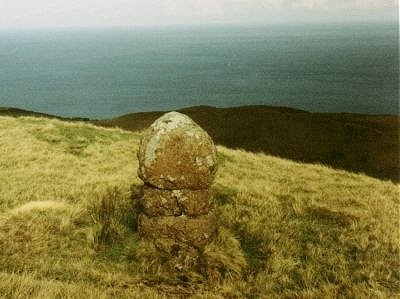
Phallic stone, Ballygilbert, county Antrim
But in Ireland, a surprising number of phallic carvings survives. The British Isles must once have been littered with phallic stones, pillars and carvings. Celtic society, like all patriarchal societies, had the cult of the penis at its core, to the extent that the human body itself was seen as a phallic object or symbol, and the severed head on a pillar a symbol of penis-power erected at strategic points on boundaries and at entrances. Lug the potent male sky-god gave his name to strategic sites still famous: Lyons, Laon, London, Leyden, and perhaps Lucca - just as the Celts themselves gave their name enduringly to Galicia in Spain, Galicia in the Balkans, Wales, and, of course, Gaul.

click on the picture for more
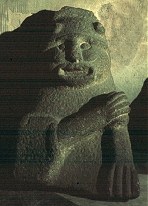
Male (ithyphallic) side of double figure at Caldragh graveyard,
county Fermanagh
The Roman Empire incorporated many cults which celebrated male energy - Orphic, Dionysiac and Panic. So, at one time, say near the end of the Roman period, Britain must have had rampant penises everywhere - from multi-phalliform lamps to marble herms (man- sized pillars with a carved bearded head on top and an erect penis stick out a third- to half- way up); from low-reliefs of penises used as signs for and to brothels, to large menhirs; from bronze age cult-figures of wooden warriors with large detachable quartzite penises (quartzite pebbles are to be found at many an Irish site, along with phalliform ogham stones and pillars), to penis-and-vulva graffiti, to phallic stones inside Cornish stone circles. Examples of all these have survived in Britain, together with some carvings associated with churches: the
'Abson Man'
crawling in megaphallic lust; the naked and handsomely-endowed male swallowed by the jaws of hell on a capital in St Peter's, Northampton; the crude ithyphallic gargoyle (from which rainwater poured through his large, displayed anus) from Margam Abbey near Swansea
.
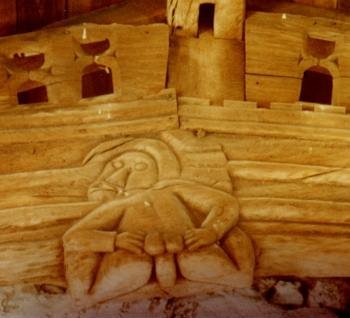
Carving on roof-beam, Queniborough, Leicestershire.
Ireland, on the other hand, a country which sees itself today as a centre of Celtic tradition but which was mostly on the periphery, and a country which did not receive all the eclectic influences of the Roman Empire (and thus probably had fewer, or a smaller repository of, phallic figures and monuments) is still littered with phallic monuments, amongst which the least appreciated are the remarkably suggestive gateposts of Ulster.

Typical Ulster gatepost near Downpatrick, county Down
That mere entrances to fields and small laneways should have such massive pillars is another Jungian quirk in the psychopathology of Northern Ireland - for these cement-rendered or whitewashed gateposts, up to a yard in diameter with glandiform, conical caps (some quite phallic) are a conflation of two Celtic - or perhaps indeed pre-Celtic - monuments: the phallic boundary marker (of which the herm is a type), and the pairs of pillar-stones which were a magical agent whereby the fertility of beasts was ensured by driving them between such - usually phalliform - stones. Pairs of pillar-stones (as opposed to the rubble-constructed Ulster gateposts) are found elsewhere in Ireland, in Britain, and, of course, in Europe.

Farm gatepost, Maghera, county Down
Some have little capstones placed or cemented on top of them (ironically reminiscent of little crosses stuck on massive phallic menhirs in Brittany to render them christian and 'safe', just as many Irish phallic stones were christianised many centuries earlier), and this may be a symbolic representation of semen, as has been the plausible interpretation of the meander- design on the glans of Ireland's most splendid phallic pillar, the Turoe Stone , a stubby granite penis some three feet high, with a Greek Key pattern to mark the fold in the foreskin. It may have stood at a ceremonial site of the first century BC, which was later enclosed and known as The Rath of Feerwore ('the big men').
click on the thumbnail for a larger picture

It is the finest example in Ireland of an array of phallic stones ranging from a few inches to several feet in height.
An wilder example occurs on the S flank of the Bricklieve Mountains of Sligo, not far from the Carrowkeel passage-tombs.

photograph by Martin Byrne
Known as "The Dagda's Stone" after a priapic Irish creator/fertility god, and by some as "The Dagda's Dick", it surveys a wedge-tomb and a glacial erratic rocking-stone known as "The Stirring Rock" which was the scene of Lammas fertility-festivities on "Bilberry Sunday" up to the beginning of the twentieth century.
The smaller phallic stones occur at holy wells and patterns and cure-sites, and at multiple bullauns.
Bullauns
(artificial hemispherical hollows in rocks or boulders) have never been fully 'explained'. They may have served as mortars for herbal potions, but the sexual symbol of pestle and mortar is universal - and where you find female symbols you often find a complementary male one, and vice versa. A fine multiple-bullaun with a small phallic stone placed in a circular perforated stone base an be seen at Feaghna in Kerry. Bullauns are almost always associated with christian(ised) sites, and may predate them. Mostly they are of the single or double type, and often have spheroid 'turning stones' with which to effect magic or cures, or to honour a divinity-turned-saint, by saying a prayer while turning them. These would be no use a pestles, and may have replaced phalloid stones which were carried off - rather as some of the smaller cross-slabs from sacred sites have journeyed back and forth across the Atlantic to heal dying migrants and their descendants.
The large phallic pillars occur all over Ireland, sometimes christianised, and at Tara the Lia Fáil (Stone of Destiny) competes for attention with a hideous and intrusive concrete effigy of St Patrick. At another important cult site, Emáin Macha (Navan Fort) the sacred centre was a phallic pillar of wood.

Multiple bullaun, Feaghna, county Kerry.
Still in prehistoric times, free-standing holed stones (again not satisfactorily explained or explained away) mostly have their perforations at groin height, and of a diameter suitable for the ritual insertion of a living penis.
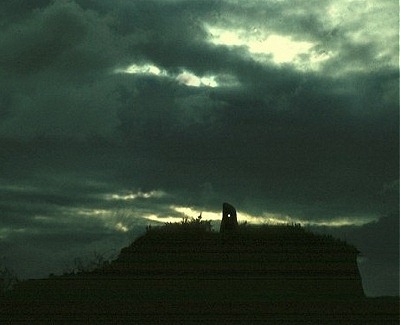
click on the picture for a closer view
The Hole Stone, Doagh, county Antrim
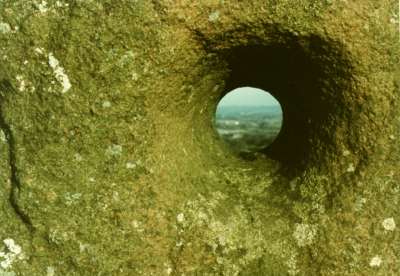
Detail of The Hole Stone
Such are the Hole Stone at Doagh (Antrim) which relates to
The
Craw Stone
at Crows in Wigtownshire, across the strait in Scotland;
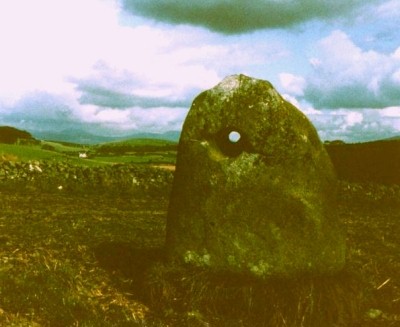
The Craw Stone, Crows, Galloway
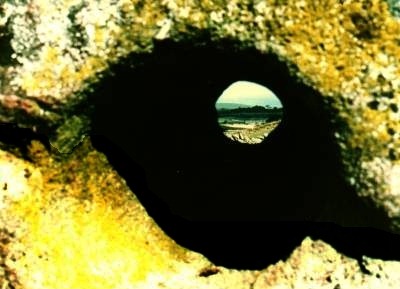
the crudely-christianised stone at Layd church in the same county (now a grave marker); stones at Aghade in Co. Carlow, Lackendarragh, Caherurlagh and Kilquhane
("the Sinners' Stone")
in Cork, Feaghmaan West (Kerry), and cross-slab at Castledermot (Kildare). Other perforated monuments clearly served different purposes (for example, those with holes high up as on the cross at Carrownaff (Donegal) and the cross-pillar at Monasterkieran on Aranmore in Galway).

Perforated cross at Bonamargy Friary, Ballycastle, county Antrim
Prehistoric tombs had 'kennel holes' in their door- slabs; and tomb shrines, for example at Bovevagh and Tamlaghtard (Derry), Carrownaff (Donegal), Saul, (Down) and Killabuonia (Kerry) have hand holes for touching the relics of the saint, in a similar kind of sympathetic magic to that of inserting the penis in a perforated slab to attract or ensure fertility.
At Aghowle church in Wicklow a very phallic stone about three feet high occurs with a bullaun and a perforated slab on the same site. Some of the holed stones have been used in living memory to cure barrenness in livestock or in people (by passing a garment through the hole) - a function also enjoyed by some of the phallic pillars.
One of these, with the Jungian title of 'The White Wife' at Carnalridge in Co. Derry, used to be whitewashed every year - just as the phallic gateposts were, and just as some other phalliform stone in north-east Ireland continue to be painted orange in the month of July. 'The White Wife' is phallic, but from one side looks like a bent old woman - but it is not called 'The White Widow ' or 'The White Hag ' .
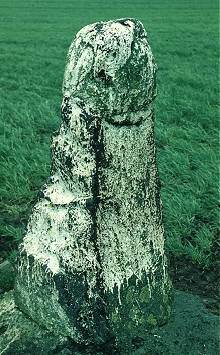
The White Wife, Carnalridge, county Antrim
At the other end of the country, at Coolineagh in Cork, an ogham pillar is crowned with a lump of quartzite known as caipín ólann (St Olann's Cap). Originally there were two superimposed stones but because of the phallic character and popularity of the pillar as a cure stone for barrenness, a local priest removed them. They were soon replaced by the present caipín (or a predecessor). Small capstones occur on the Ulster gateposts (see above) and larger, phallic ones (some removed) were tenoned to the tops of the carved crosses of Western Ossory. Sometimes paired pillar stones are quite obviously male and female (the latter with a grooved top). Good examples are at Boherboy (Dublin), Cabragh (Cork) and Sandville (Tyrone). Both phallus and vulva occur together at Boa Island (Fermanagh), where a famous double 'Janiform' torso (two back-to-back figures) is gouged female on one side and has a phallus carved in relief on the other. This site was evidently yet another sanctuary of great importance, and is still a place of powerful atmosphere.
It is not until the Romanesque period that whole figures with realistic genitals start to appear in Ireland. These generally represent the sin of Concupiscentia (Lust), and one of the earliest occurs in an Irish-influenced Anglo-Saxon manuscript now in the Vatican. In a 'Canon Table' or list of textual concordances, a rather monkish male figure pulls his beard and indicates his genitals, which are being attacked by snakes, as is his moustache. He is being eternally tortured in Hell for one or all of the sins of Lust (Irregular Motions of the Flesh, etc.) and the snakes attack not only his genitals but his secondary sexual characteristics.
Later female figures of Luxuria (the spending of wealth on luxury) have their expensive hairpieces and their breasts similarly attacked, more often than their genitals. There are large numbers of male and female exhibitionists (some depicted as committing their sin, others as suffering for their sin, some also committing other sins such as Drunkenness and Unnatural Acts from contortionism to sodomy) on Romanesque corbels and capitals, especially in France.
It is not surprising, therefore, that coital and phallic carvings, masquerading as Sin, should survive among the Romanesque and mediæval ruins of Ireland. On a window of a twelfth-century church at Annaghdown (Galway) a fine ithyphallic dog (symbol of lust and abandon) can be seen.
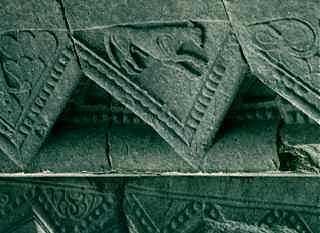
Detail of archivolt, Annaghdown, county Galway
a remarkable fifteenth-century carving now built into Kilkea Castle (Kildare) shows a bearded and phallic-helmeted man straddling and being gripped by an ithyphallic man in a boar mask, or a boar-man, while being gnawed from behind by an ithyphallic quadruped and having a bird attack his breast. This may be a unique representation of the Temptation of St Anthony, in which the boar-figure is reminiscent of theriomorphic or masked men on the crosses at Castledermot in the same county.
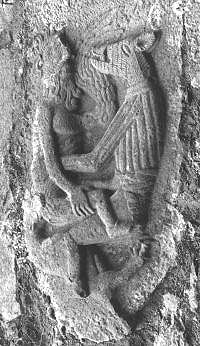
Kilkea Castle, county Kildare
Lustful beasts are a feature of Romanesque iconography, but are not usually associated with (later) temptation scenes involving St Anthony. The Kilkea carving may be a kind of confused palimpsest - or like some mediæv
al
'Sheela-na- gigs'
and male exhibitionists quite obviously mis-copied from French or Spanish Romanesque carvings seen on the Pilgrimage to Compostela. Such is a carving on the corbel table at Grey Abbey (Down) which shows a male torso from behind, displaying anus and scrotum but no penis; while from each shoulder stares a mask or head. This is modelled on corbels at Saint-Martin-de-Sescas (Gironde) and Sablonceaux (Charente-Maritime), both on the Pilgrim Roads. Near to this corbel is a pure Aquitainian Romanesque head of a sow, like the boar, a symbol of concupiscence and lechery.
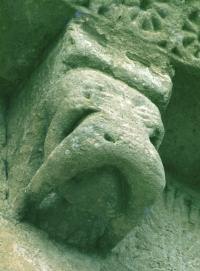
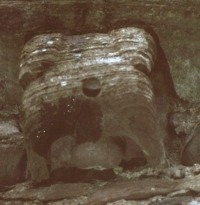
Corbels at Saint-Martin-de-Sescas (left) and Grey Abbey (right)
Another Romanesque corbel from Aghalurcher (now in Fermanagh County Museum) is quite clearly influenced by corbels and capitals at La Sauve-Majeure in the Gironde. The Aghalurcher figure is a bearded feet-to-ears acrobat displaying, like the Grey Abbey corbel, testicles but no penis.
In the same French 'school' is the window-top from Tomregon (Cavan) which shows a bearded, torso-less figure from behind, displaying scrotum but no penis, his long arms being pulled by monsters. This figure has clear affinities with grotesque capitals in the Loire Valley, notably Cunault.
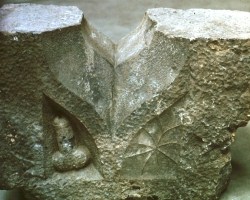
Window-top (shown upside-down) from Smithstown Castle
A later mediæval window-top from the sixteenth century Smithstown castle (Clare) is decorated with a curious 'spider web' design and a well-observed penis and scrotum. This recalls similar images of male concupiscence on corbels of churches in Western France. A human figure carved on a gate post at Ballycloghduff (Westmeath) brandishes a key in one hand and a huge penis with the other.

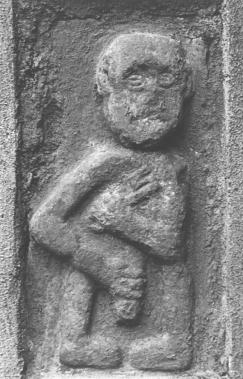
A similar figure (interpreted as St Peter and equally undateable) survives only from the waist up at Broadford in Co. Clare. Are these palimpsests? Do they convey the message that sexual control will provide the key to Heaven? Although their 'meaning' may range from potency to sin, and may be ambiguous or downright obscure, phallic symbols are universal, and they survive universally, whether or not they are consciously seen as phallic. Just as an English female exhibitionist figure was pointed out to visitors as 'the last man hanged on Hangman's Hill', so the Smithstown Castle carving was wilfully interpreted (turned upside down) as a mason's mallet.
Ulster people pass their remarkable and fast-disappearing gateposts daily without consciously noticing their phallic (and fungoid) caps. Any unrepressed person would recognise some holed stones as patently coital in significance, and the meander design on the Turoe Stone as stylised semen, but our half-repressed, sex-obsessed culture perversely refuses to see the obvious, the natural. The explicit functions of these disparate carvings were certainly different, but because we see the world in terms of obscurity, we lump them together (as I have done) - just as the British Museum and the Museum in Naples had their famous Special Collection and Gabinetto Segreto in which all 'obscene' material was placed, regardless of culture, context, function or period. Yet the phallic symbol is timeless as well as universal: it pops up in neon votive lamps, in Victorian pepper-pots, and in car and motorbike design. Since the eighteenth century, however, its recrudescence has been unconscious rather than conscious, indicating that our culture is getting more complex in its repressions.

Old gate-pillars near Killyleagh, county Down.
Ireland is fortunate that the middle class hypocrisy which invaded the country from the close of the eighteenth century on, but especially after Catholic Emancipation, did not wreak damage to the past and the Collective Unconsciousness on the scale that earlier occurred in England. The Stone of Feerwore (Turoe) , and Lía Fáil remain revered monuments and may well outlive the tawdry concrete statues of St Patrick.
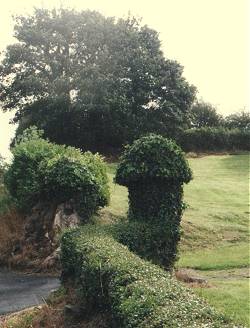
Ivy-clad phallic gatepost, Downpatrick, county Down
And while old Ulster gateposts are disappearing as farm machinery makes increasing demands, some of the more grandiose (if bungaloid) dwellings in the North have renewed the tradition with enormous (sometimes grotesque) modern versions.

Postscript
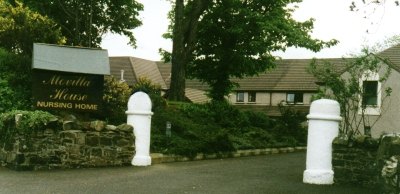
While there is something of a renaissance in phallic gate-posts at least in the north-east of Ireland, the picture below shows a Victorian pair in Newtownards, county Down, which was 'bowdlerised' by truncation when the big house was razed to make way for a modern Nursing Home. I have 'restored' the pillar on the left to show what the gateposts were originally like. Note that the tradition of whitewashing phallic pillars survives even on truncated examples .
Anthony Weir is author of
Early Ireland - a field guide
(1980), and co-author of
Images of lust: sexual carvings in medieval churches
(1986, 1994, 1999).
Versions of this article were originally published in
Archæology Ireland,
Vol.4, No.2, and in
Mercian Mysteries
, No.15, May 1993.

|
|

or
|
|
|
I am indebted to Bob Trubshaw,
|