

|
|

IRISH CROSS-PILLARS
AND CROSS-SLABS
part one
text and photographs by
Anthony Weir
There are many unique pictures on this page:
please be patient while they download.
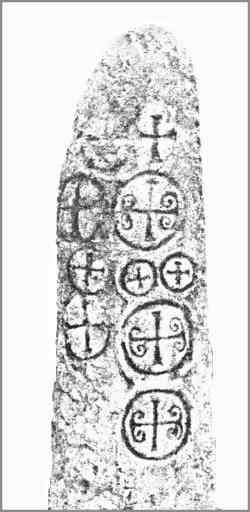
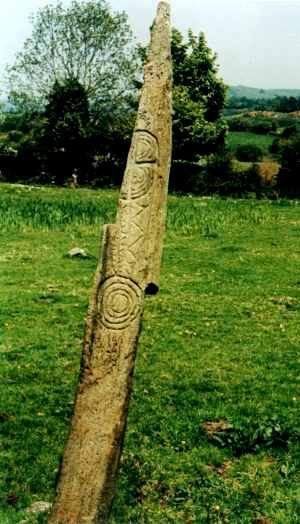
Kilnasaggart, county Armagh: detail of Christianised pillar-stone
(south side)
For a full view in colour of the inscription on the north side, click on the image above.
Just as
ogam
inscriptions were added to already-standing stones of considerable antiquity, so, with the remarkably peaceful Christian penetration of Ireland, menhirs and sacred boulders attracted Christian appropriation.
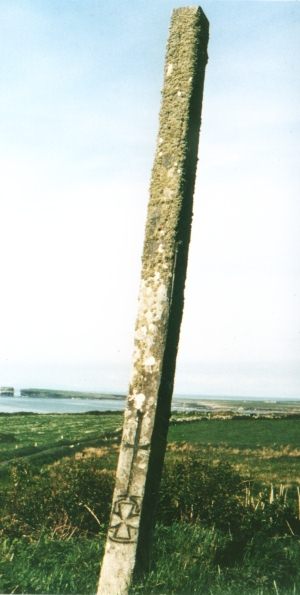
Dunfeeny, county Mayo
Although the largely-legendary St Patrick is credited with overturning 'idols' all over the island, in the unique and traditional Christian manner, it may have been just as satisfying in the 6th century - and much more permanent - to Christianise a 'pagan' stone as to destroy it. As late as the 19th century 'pagan' stones removed by priests had a propensity for returning to the spot.
Lankill, county Mayo
Some of the Christianisations had a distinctly prehistoric look, suggesting that the Irish church (which was nothing like the modern Catholic church, but much more like the Coptic and Syrian churches) was rather more receptive and assimilative than others in Europe.
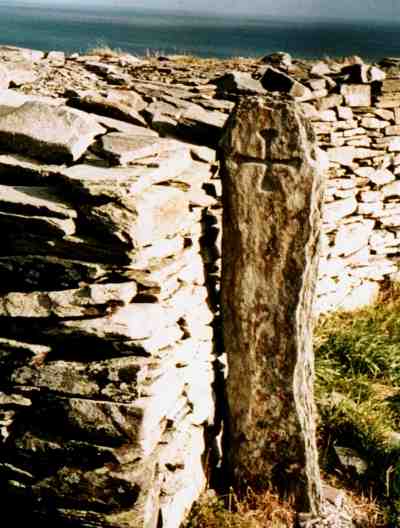
Cross-pillar inside the entrance to a fortified farmstead,
Knockdrum, county Cork
By and large, the inhabitants of Ireland welcomed this tolerant form of Christianity, with its fantastic redemption, as a relief from the dark rites and realistic fatalism of Celtic religion.
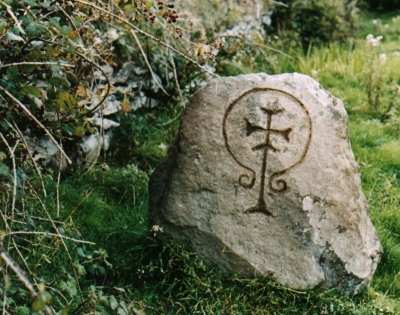
Kilvickadownig, county Kerry: a design on a boulder
which incorporates an A for Alpha (the foot of the cross)
and an Omega (
W
) forming a curclicued nimbus around it.
Celts had holy stones and holy wells and worshipped trees, streams, groves, glades and
genii loci
. Irish Christianity seemed to be able to accommodate all these except the trees - and it was with the proliferation of wealthy monasteries from the eighth century onward (and the Norse attack that they attracted) that the first serious deforestation since Neolithic times occurred. Ireland, like Scotland, was largely covered with deciduous and holly-tree forest.
It is now the most-deforested country in Europe.
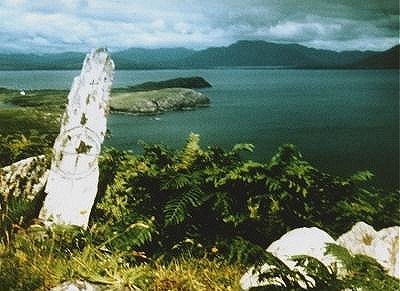
Kildreelig or Killerelig, county Kerry
Irish Christianity was essentially monastic and almost federal, whereas Catholicism is episcopal, hierarchical and totalitarian: "
E pluribus unum
"! The Irish church had no Rome-appointed head until St Malachy of Armagh went to Rome in the 12th century and had himself appointed Archbishop.
While large monasteries were established on the fat cattle-lands of the East of Ireland and around the central Bog of Allen which covered a great deal of the interior, little monasteries were established in remote places, often called Diseart or Dysart , after the Latin Deserta . Monks modelled themselves on the early Desert Fathers, and the first monk of all, St Anthony the Hermit, was the model for those few who went off to solitary spots, often on islands or islets, and subsisted on seabirds, sea scurvy-grass and shellfish while praising the glory of God as presented to them by wild and spectacular Nature.
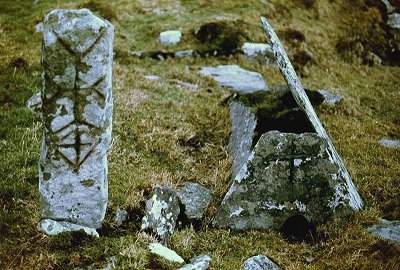
Pillar and Tomb-shrine with armhole
for touching the bones of St Buonia,
Killabuonia, county Kerry
All over the island, monks found, carved and erected cross-pillars for themselves. Today these are found in the remnants of old monastic settlements, often with holy wells, with altars of loose stones called
leachta,
and sometimes with rare surviving tomb-shrines and sacred (or magic) stones.
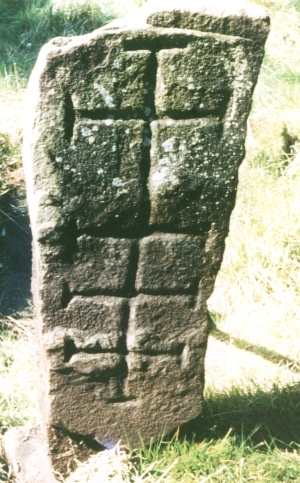
Carnacavill, county Down
These pillars can be quite small and crude - but they took considerable effort to carve when the stone was not easily worked: flaky schists, shales and granites are the most commonly-found in the old monastic sites.
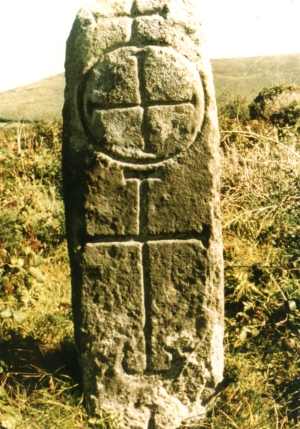
Lateevemore, county Kerry
But, even in remote places, rather finely-carved pillars were put up.

Cloon West, county Kerry
There are wonderful variations on the basic designs of the Latin and Greek (equal-armed) crosses.

Currauly, county Kerry
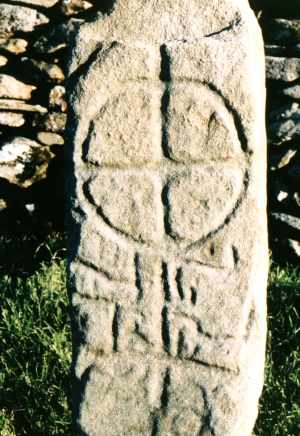
Gallerus, county Kerry
Non-geometric elements were introduced to the designs.

Caherlehillan, county Kerry:
a dove (?) and snakes or trumpets (?)
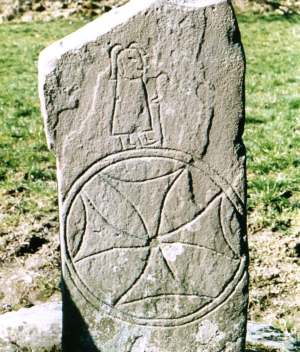
Ballyvourney, county Cork:
a 'wheel' cross surmounted by a monk
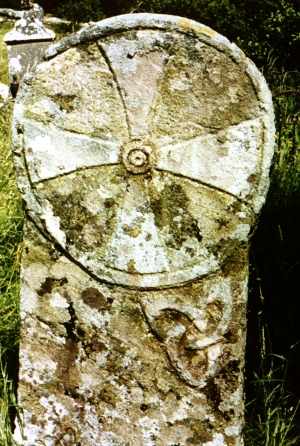
Killaghtee, county Donegal: a 'wheel' cross above a triple knot of Brigid
probably representing the Trinity
Cross-designs often combined in different ways and proportions rectlinear and curvilinear elements.
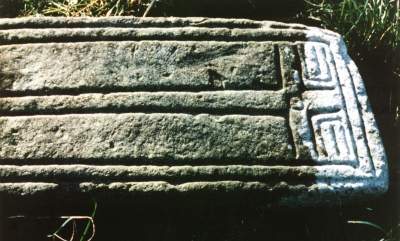
Castletown, county Meath
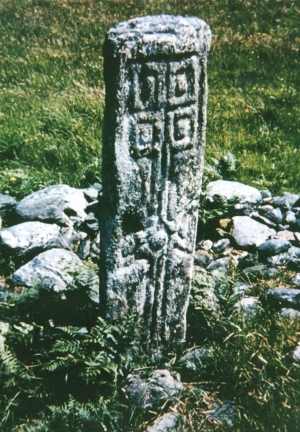
Glencolumcille, county Donegal
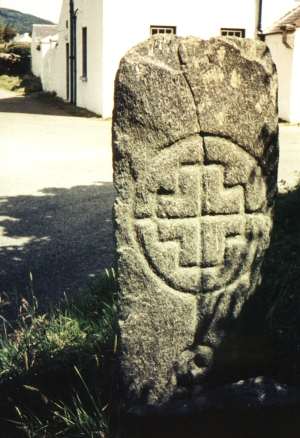
Glencolumcille, county Donegal
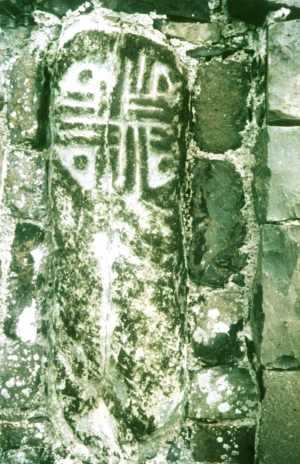
Templastragh, county Antrim
They could incorporate the Chi (X) Rho (P) symbol derived from the first two letters of the Greek
CRISTOS
(
'Christos'
meaning
'anointed'
- which of course he never was: he was baptised!)
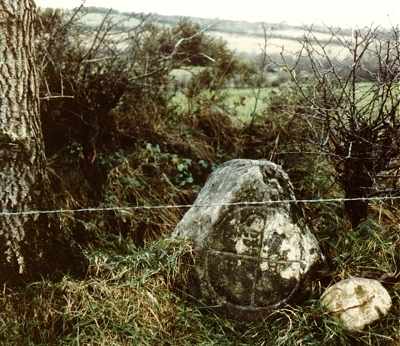
Drumaqueran, county Antrim: the Rho (P) - a curclicue on the top arm of the cross - is the wrong way round on this side, but the right way round on the other side of this boulder
The Alpha (
A,a
) and Omega (
W,w)
were also popularly incorporated, as we have already seen.
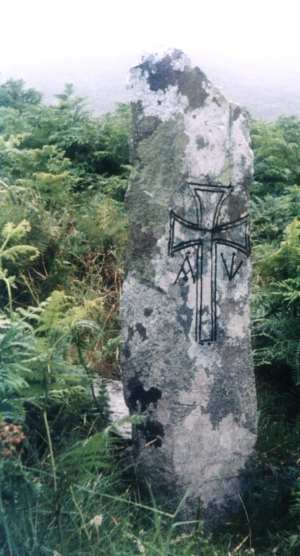
Loher, county Kerry
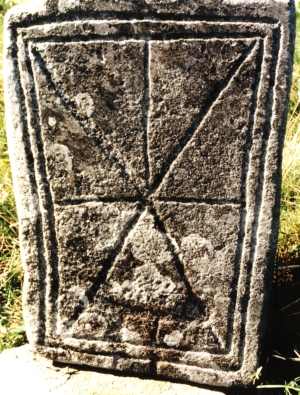
Toormoor or Toormour, county Sligo: an entirely rectilinear design which ingeniously incorporates an Alpha (A), in the bottom half, with an Omega (
w
)
in the top half of the slab
Some strikingly incorporate Neolithic passage-tomb designs to great effect - while also obviously influenced by the Danish-Scandinavian motifs of Northern English 'Hogback' Stones.
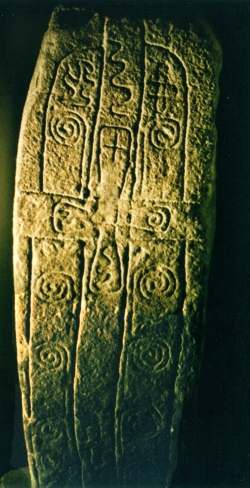
Kinnitty, county Offaly
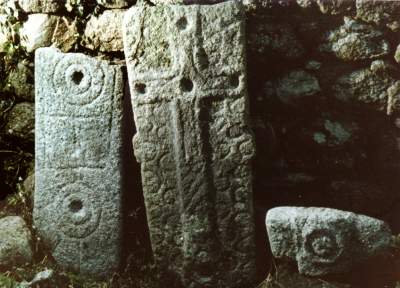
Killegar, county Dublin
These at Killegar are, of course, not pillars, but grave-stones in the Scandinavian tradition.
Irish grave-stones - or, more properly, cross-slabs - will be discussed and illustrated on the next pages, together with the large crucifixion-slabs which are primitive forms of the well-known sculptured or 'scripture' crosses of the rich and richly-meadowed Midland monasteries.
 proceed to part two
 top of page
 return to home page