

|
|

IRISH CROSS-PILLARS
AND CROSS-SLABS
part two
also introducing
BULLAUNS
text and photographs by
Anthony Weir
There are many unique pictures on this page:
please be patient while they download.
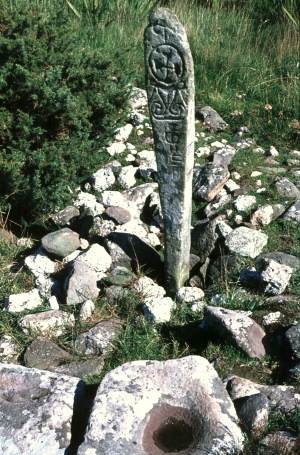
Kilfountan, county Kerry
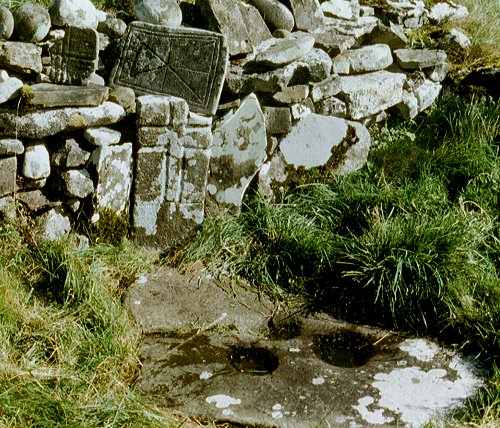
Toormoor or Toormour, county Sligo
In many places all over Ireland, like Toormoor (above), remains of a monastic site have been gathered together to make a
leacht
or altar, beside a multiple
bullaun
(bottom centre).
Bullauns
(from a word which can mean 'bowl', 'bull' (animal or papal) and 'ball') are usually associated with monastic sites, but their origin and function(s) are almost certainly earlier. They are hemispherical depressions hollowed out of small or large boulders - which may have anything from one to fifteen
bullauns
.

Triple bullaun from Ardtole church, county Down,
now outside the church at Chapeltown
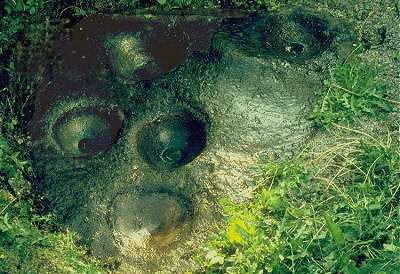
Multiple-bullaun, Cong, county Mayo
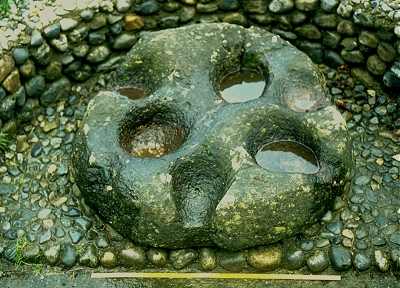
Multiple-bullaun, Gortavoher, county Tipperary
Some have a continuing ritual use, involving the saying of prayers and the turning of smooth pebbles in their hemispherical beds.
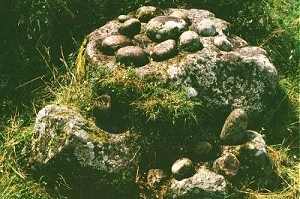
click on the image for a larger picture
Multiple-bullaun, Killinagh, county Cavan
The water-smoothed pebbles can occur on their own as cure-stones (or curse-stones), as on the island of Inishmurray

Clocha Breaca
(Speckled Stones), Inishmurray
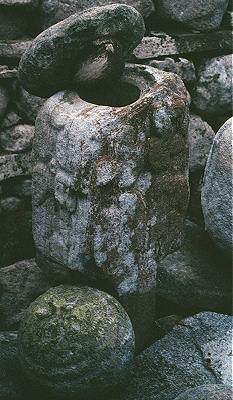
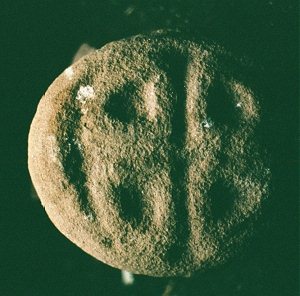
or at another Sligo site where each stone was turned with a Lord's Prayer and a shoelace was tied around the minuscule pillar to ensure that the affliction was firmly left behind.
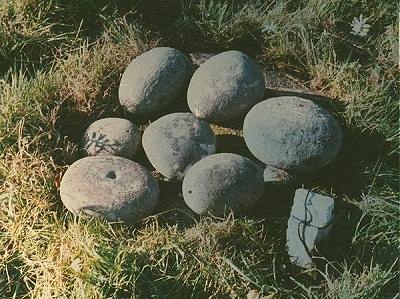
Cure-stones, Killerry, county Sligo
Possibly enlarged from already-existing solution-pits caused by rain, they are, of course, reminiscent of the cup-marked stones which occur all over Atlantic Europe, and their significance (if not their precise use) must date from Neolithic times.

Deep, ringed cups and solution-pits on the front roofstone of a
Wedge-tomb
in Burren, county Cavan
Thus some are associated with megaliths:

Templebryan North, county Cork, on a very dull day
and others look anything but Christian.

Feaghna, county Kerry: multiple bullaun and phallic pebble-and-socket
In the graveyard at Killadeas in county Fermanagh are a number of curious stones, including a relief carving of an ecclesiastic ( The Bishop's Stone ), a broken phallic pillar, a perforated stone, and a multiple-bullaun (or slab with very large cup-marks) set up on its edge and Christianised on the other side with a cross in relief.
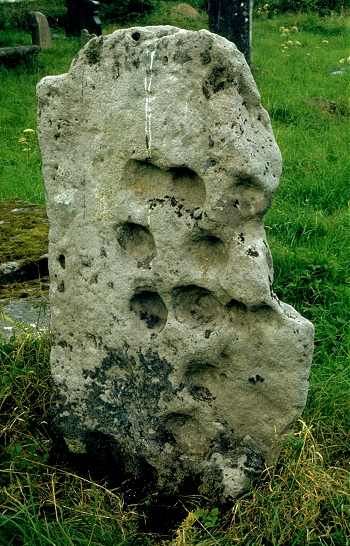
On this Killadeas stone the depressions could be interpreted
either as Bullauns or Cupmarks
At Ardane, county Tipperary, river-rounded pebbles (not in the photographs) occur together with cross-slabs and a holy well within a fairly-modern enclosure - so the attraction of round pebbles and hollows transcends the ages - and the faiths.
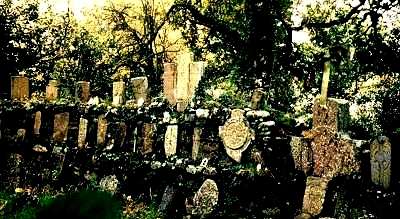
"St Berrihert's Kyle", Ardane: always a place of poor light
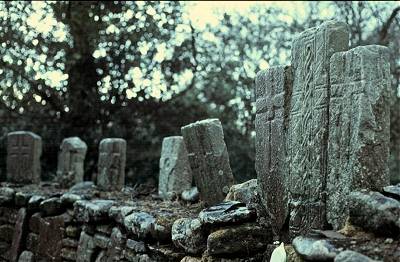
Most of the little slabs at Ardane are actually pillow-stones - originally placed under the head of a dead monk in his grave. Hundreds of them survive in the Midlands of Ireland.
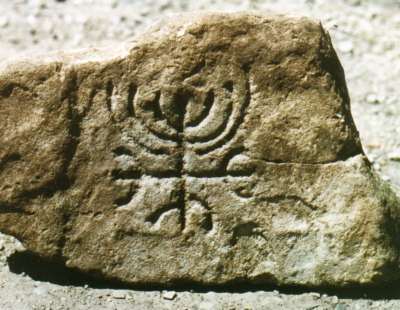
Cloontuskert, county Roscommon
One in county Roscommon has a combination of motifs: the 'cross-crossy' and the sacred Jewish menora.
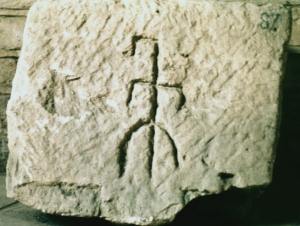
Poitiers (Vienne), France:
roughly-contemporaneous Merovingian cross-decorated stone
The Irish carvings have their origins, of course, in continental Europe - and in Egypt.
Not all small slabs were pillow-stones. Some are obviously trial-pieces, as one of a little group at Saul.
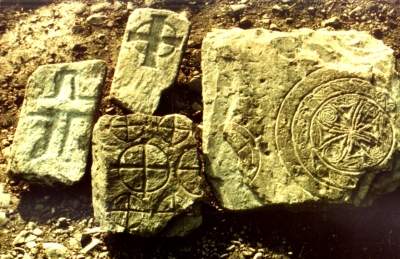
Cross-slabs from Saul and Raholp, county Down
The large rich, central monasteries have left us the largest number of cross-slabs, which became larger and were placed on top of the grave rather than in it.
Sometimes they were personalised with the name of the dead monk
.
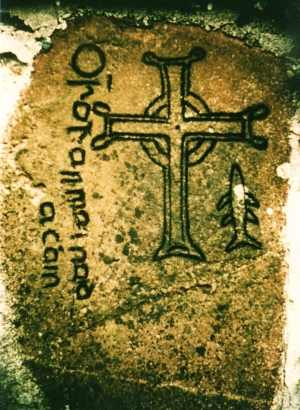
Fuerty, county Roscommon: the inscription reads
Or do anmain Adacáin
- A prayer for the soul of Adacán.
The fish might hark back to the Sacred Salmon of Wisdom,
or to the
I
.X.
Q.E.U.S
(Ichtheus=Fish) acronym for
Jesus Christ,
Son of God, Saviour,
popular before the adoption of Christianity
as a religion of Empire by Constantine - or Adacán might simply
have been an excellent fisherman.
At Clonmacnois hundreds have been found, some of which are very elaborate, and date probably from the 11th or 12th century, whereas others might be four or five hundred years older.
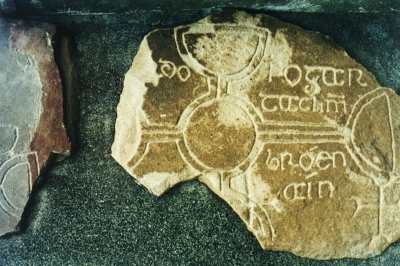
Clonmacnois, county Offaly
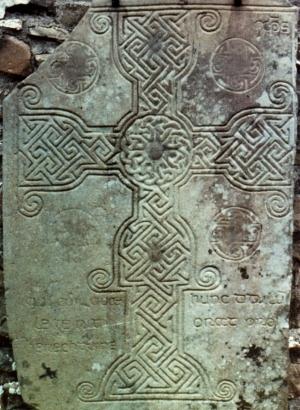
Tullylease, county Cork - the Latin incription reads:
Quicumquæ hunc titulum legerit orat pro Berechtuine
(May whoever reads this pray for Berechter)
The distinction between cross-slabs and cross-pillars is blurred. Some larger slabs have subsequently been erected as pillars. And some fallen cross-pillars look like slabs...
 proceed to part three
 top of page
 return to home page