|
photo by Michel Polard 
Detail of "kennel-hole" in the southern dolmen of the aligned megaliths at Wéris in Belgium (3 kms N of Erezée in the eastern Belgian province of Luxembourg) . |
Tell-A-Friend
EAST OF
BRITTANY:

click on this image to enlarge
SOME MEGALITHS
OF WESTERN FRANCE
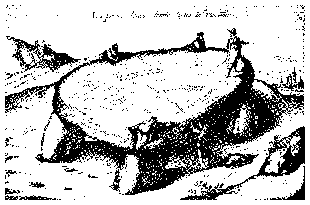
A 16th century sketch of the Pierre Levée , Poitiers
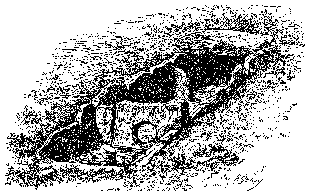
A 19th century drawing of the Gallery-tomb
in situ
at Conflans-Sainte-Honorine (Oise)
text and photographs by
Anthony Weir
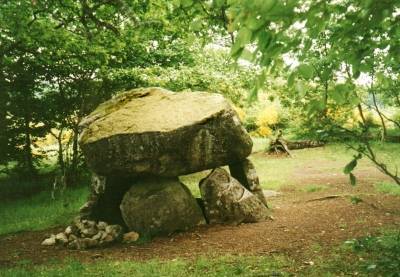
Dolmen of the type known in French as Dolmen Simple at Crocq (Creuse)
Beyond the well-tramped and sometimes overrun sites of Brittany, the megaliths of France are little known and little visited.
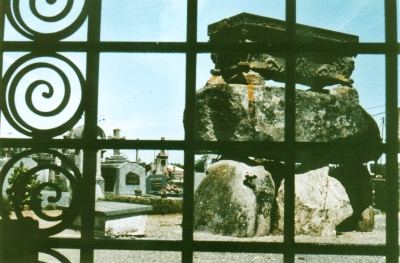
Dolmen moved to the churchyard of Confolens (Charente)
Whereas France is well-supplied with comprehensive and widely-available guides to Romanesque churches, there are none (in English) for the thousands of prehistoric tombs and menhirs outside Brittany.
In Britain it is the other way round.
The megalith-hunter in France must resort to the random marking of megaliths by a p on Michelin maps,
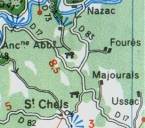
detail of a Michelin map
showing some of the dolmens on page 3
to the equally random mentions in tourist pamphlets,
to the occasional battered or home-made sign labelled
"Dolmen"
, or to books long out of print, such as Glyn Daniel's
THE PREHISTORIC CHAMBER TOMBS OF FRANCE
(London, 1960) which I initially relied on. However, in the
départements
of Lot and Aveyron at least, many dolmens are well and elegantly signposted - as megalithic consciousness has risen.
The IGN (Ordnance Survey) 1:100,000
Série Verte
is reasonably good for prehistoric monuments, tending not to mark those which are badly ruined - but indication is very inexact. For exactitude - and cartographical beauty - the 1:25,000 (1cm = 250 metres)
Série Bleue
should be used by anyone staying in a small area.
It must be said that of the thousands of French chamber-tombs, not many have the attractiveness nor the ambiance of the hundreds scattered all over Ireland. A great many - especially those on the limestone causses and ségalas of the Centre - are just basic dolmens simples , or coffres (stone boxes, megalithic cists) of interest chiefly to professional archæologists.
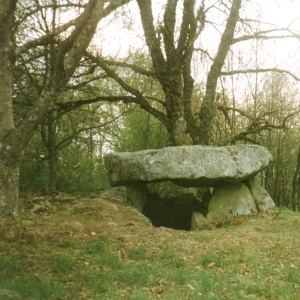
Planchat (Creuse)
But there are still (at the very least) scores of megaliths worth visiting .
Most are to be found in woodland,
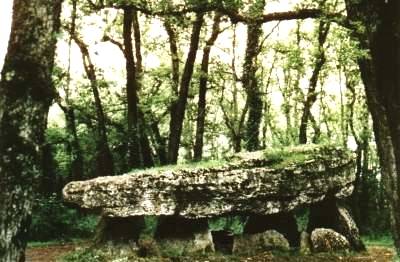
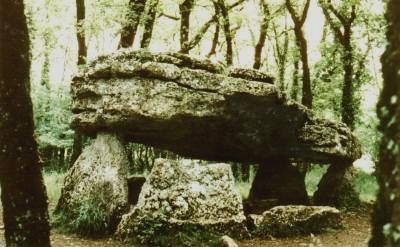
Saint-Saviol (Vienne): Dolmen de la Pierre-Pèse
but not a few are by the roadside,
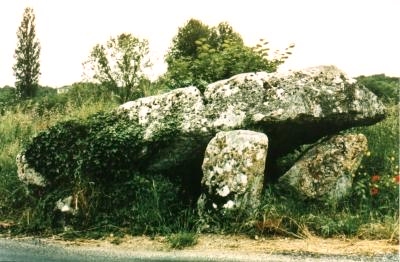
Monas (Vienne)
some in fields, and some have been dismantled and hauled (even hundreds of miles) to châteaux or to graveyards.
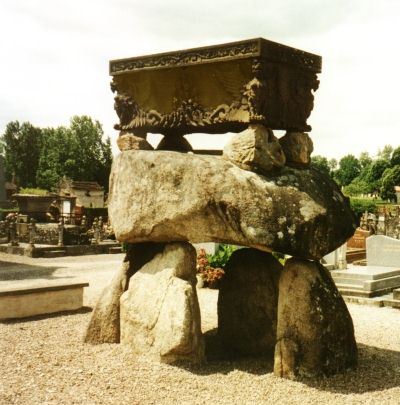
Confolens (Charente): a
simple dolmen
moved to the town churchyard
as a support for an antiquarian's sarcophagus.
- or to the dry moat of the palace of Saint-Germain-en-Laye, north-west of Paris, which is now France's foremost and marvellous archæological museum .
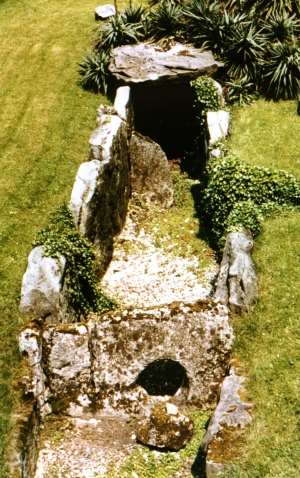
Gallery-tomb
(allée-couverte)
from Conflans-Sainte-Honorine (Oise)
- with the sealing stone for the pierced entrance
.

 Two views of the perfectly-preserved door-slab of
La Pierre aux Fées
,
Two views of the perfectly-preserved door-slab of
La Pierre aux Fées
,
an
allée-couverte
at Villers-Saint-Sépulcre (Oise)


...and a detail of a side-slab showing a small natural orifice or perforation strategically-situated in the limestone.

Villers-Saint-Sépulcre (Oise)
The 'bung-hole' (or 'port-hole') at the entrance to the Conflans tomb and others in the same part of the Ile-de-France is found in many European tombs in Europe and the Caucasus.
A variant is the 'kennel-hole' - some fine examples of which are to be seen also in the southern French
département
of the Hérault, north of Montpellier, and at Wéris in Belgium.

La Bertinière also known as La Sauvagère, (Orne)
The selection presented here is also necessarily random. Most of them were visited during my various travels in Western France in search of
exhibitionist carvings on Romanesque churches
, and their origins.
Some I photographed without marking them on my map, or I have subsequently lost the map (as I have repeatedly done with cameras).

This one I do not remember photographing and know only that I came across it somewhere in the Centre-West.
So this web-page is not itself a guide. It is, rather, an invitation to the English-speaking megalith-lover to explore the hidden treasures of a country brimful of other attractions (except to vegetarians).
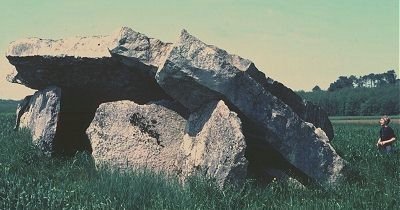
Tomb with collapsed capstone at Bouchet, near Gennes
(Maine-et-Loire)

|
This site is a member of
:
Click here for information
|

