|
|
|
|
Tell-A-Friend
EAST OF
BRITTANY:
part II
text and photographs by
Anthony Weir
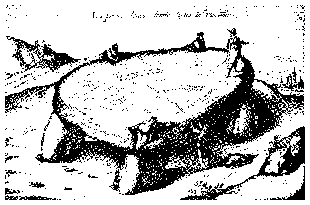
A sixteenth-century sketch of the Pierre Levée , Poitiers
The tombs shown on this site are either the squat
Dolmens simples
which resemble the æsthetically more-impressive Irish
Portal Tombs
, or long gallery-tombs of the type known in France as
Allées-couvertes
(covered passages).
The well-known sepulchres of Brittany are mainly Passage-tombs, which are rare elsewhere in France - and relatively rare throughout Europe. In Gallery-tombs the gallery is the tomb, so to speak, whereas in Passage-tombs the passage leads to the tomb proper, which is a larger space or chamber. All megalithic tombs in France tend to be called
dolmens
(from the Breton for 'stone table'), and Passage-tombs are often - confusingly - called
Dolmens à galerie
. But they can, more accurately, be termed
Dolmens à chambre et couloir
.
Quite a few French tombs, especially Dolmens simples , still have their covering and surrounding mound (tumulus or cairn).
Some of the
Allées-couvertes
are huge. The
Grand Dolmen
of Bagneux East (now a suburb of Saumur) is the largest megalithic chamber in Europe. Dances and banquets have been held within it - and it has for over a century been part of a café-bar.
Tombs like this never had a covering mound or cairn, but were a kind of Temple-tomb rather more primitive than those found in Malta.


 Bagneux East, Saumur (Maine-et-Loire
)
Bagneux East, Saumur (Maine-et-Loire
)


Others - especially Dolmens simples of the limestone plateaux known as causses - are as small as a Megalithic Cist ( Coffre in French) or the smallest Irish Wedge-tomb.
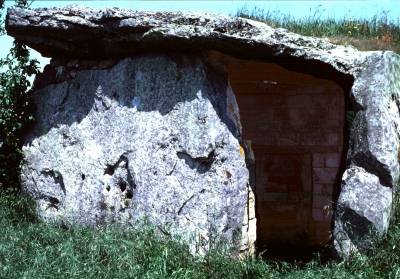
The Dolmen de la Madeleine , one of several Allées-couvertes near Gennes was adapted to become a bakehouse (long since disused), and others have, naturally, become storehouses and sheds.
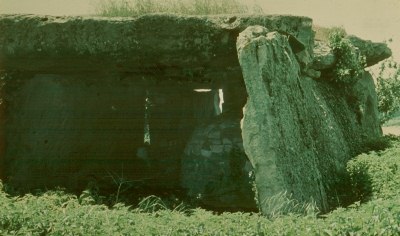
Gennes (Maine-et-Loire): bread-oven inside a large tomb
known as the
Dolmen de la Madeleine
;
and the same tomb from the front, narrower, lower end.
French dolmens rejoice in a variety of names. Whereas Irish tombs tend to be Giants' Graves or (after a couple of fleeing legendary lovers like Tristan and Isolde) Dermot and Grania's Bed , French tombs are mostly more prosaically described as Pierre-Levée (raised stone), Pierre Folle (crazy stone) , Pierre Couverte (covered stone), Pierre-Pèse (heavy stone), or Pierres-Plates (flat stones) - though some, especially in the West, are associated with spirits or genii loci : La Grotte or La Roche aux Fées (Fairy Rocks or Grotto).

La Pierre Lev
ée
, in a south-eastern suburb of Poitiers (Vienne)
(see drawing at the top of this page)
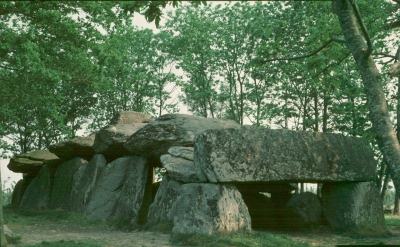
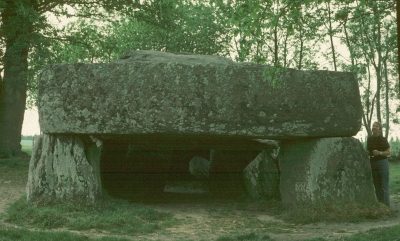
La Roche aux Fées
, Essé (Ille-et-Vilaine),
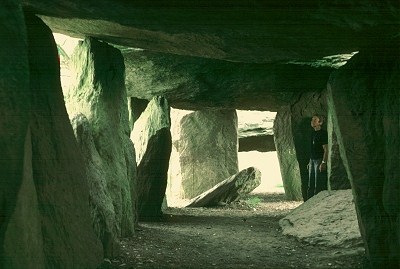
with interior headroom of two metres and
big enough to be used for Kermesses
In a more literary vein, one that I have not yet visited in the
département
of the Lot-et-Garonne is known as 'Gargantua's Bed'. More prosaically, a fine and large Gallery-tomb in Brittany is known as 'The Merchants' Table' because it made a handy stall for itinerant pedlars.
One was known as
Le Caveau du Diable
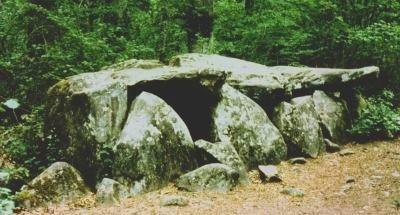
Dolmen de la Contrée , Ernée (Mayenne)
(The Devil's Cave) as well as Dolmen de la Contrée .
Others have been Christianised - most dramatically the Dolmen de la Madeleine on an island in the river Vienne, whose (preumably three or four) supporting uprights were replaced in the 12th century by four elegant Romanesque columns, to make it into a little shrine.
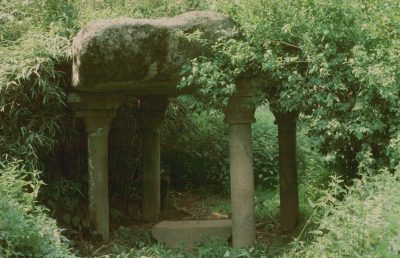
Dolmen de la Madeleine , south of Confolens (Charente)
A menhir on the borders of Brittany and South Normandy was Christianised with a niche for a statuette now gone.
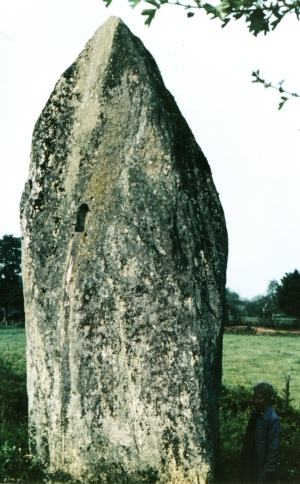
Menhir de Pierre Frite (Mayenne)
while one of the most beautiful menhirs in the world now stands at the corner of the façade of Le Mans Cathedral.

Monolith at Le Mans (Sarthe)
This selection of photographs has been made mainly from æsthetic considerations, for I think that the value of megaliths lies in their sculptural beauty and ambiance rather than their antiquity: after all, none is older - or more beautiful - than the stone of which it is composed.
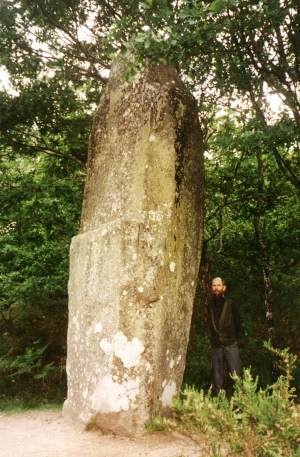
The author and Menhir at Cinturat (Haute-Vienne)

La Pierre Couverte , Baugé (Maine-et-Loire)
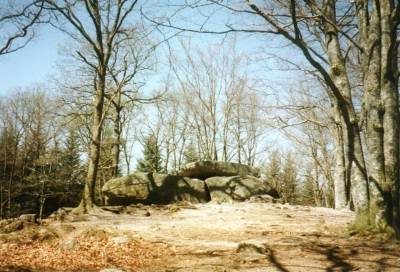
Dolmen de la Chevresse (Nièvre)