

Dissident Editions
  home     free book     reviews   feedback     about us  

logo


POETRY


poems of the month

rejoice in the dog

post-millennium maggot

dispatches from the war against the world


albanian poems

french poems in honour of jean genet

the hells
going on

suicide for
non-beginners

fearful symmetry

book disease

foreground
trouble

the transcendental hotel

cinema of the blind

lament of the earth mother

uranian poems

haikai by okami

haikai on the edge

black hole of your heart

jung's motel

leda and the swan

confession from belgrade

gloss on rilke

jewels and shit: poems by rimbaud

villon's dialogue with his heart

vasko popa:
a shepherd of wolves ?

imagepoem


BETWEEN POETRY AND PROSE

400
revolutionary maxims

nice men


ESSAYS

kamikaze and crusade

being or television

satan in the groin

womb of half-fogged mirrors

overcoming tourism

anti-fairy tales

the dog of sinope

this sorry scheme of things


Nuadú, God of War


irishgenius.org

field guide to megalithic ireland

houses for the dead

french megaliths

egregious.org


DIALOGUE WITH HIS HEART

THREE POEMS BY

FRANÇOIS VILLON (1431-1463 or later)

translated by Anthony Weir
revised versions of those published in Tide and Undertow, Belfast 1975

_______________


BALLADE OF THE LADIES OF BYGONE TIMES
from THE TESTAMENT (1462)

Tell me from where I could entice
Flora the famous Roman whore,
or Archipiada or Thaïs
who they say was just as fair;
or Echo answering everywhere
across stream and pool and mere,
whose beauty was like none before -
where are the snows of yesteryear ?

Where is the learned Héloïse
for whose love Abelard became
a gelded monk at Saint-Denis,
yet still could not put out his flame ?
And where now is that royal dame
who had men for three days with her
then had them cast into the Seine ?
Where are the snows of yesteryear ?

Queen Blanche who had a siren's voice,
white as a lily on the plain;
Big-Footed Bertha, by Heaven's choice
mother of great Charlemagne;
and Joan of Arc from proud Lorraine
the English burned from cruel fear -
where are they, where, O Mother of Men ?
Where are the snows of yesteryear ?

Don't ask,Prince, in one month again,
nor yet in twelve where they all are;
I'd only give you this refrain:
Where are the snows of yesteryear ?


THE OLD WOMAN LONGING FOR THE DAYS OF HER YOUTH (THE LAMENT OF THE "BELLE HËAULMIÈRE")
from THE TESTAMENT (1462)

I thought I heard the whore complain
who sold helmets as a cover-trade,
wishing the days would come again
when she was young; and this she said:-

"Old age, a cruel trick you've played!
Why have you struck me down so soon ?
Who'll care now if I put paid
to a life so long past its high noon ?

"You've robbed me, left me in the lurch,
taken my beauty and power away.
Businessmen, men of the Church
don't give me all they have today.

"No man was born who would not pay
all that he had to get that prize
(with some misgiving, I daresay)
which even beggars now despise.

"Many a man I could have had
but turned down in my dizziness
for true love of a crafty lad
I showered with limitless largesse.
I was unfaithful once or twice -
but Christ! I loved him -love him yet.
He only gave me churlishness
and loved only what he could get.

"He could have dragged me through the mud
and trampled on me - I would still
have worshipped him. Had he drawn blood
and maimed me, I'd have done his will.
I'd be in misery until
he ordered me to kiss him. Swine!
I was nothing but his swill -
and all I can do now is whine.

"Shame and sin are all I've left
for thirty years now since he died.
And I live on, old, grey, bereft,
brooding on my prime and pride.
Now look at me - I'm shrunk and dried,
and when I see how I have changed,
ravaged now by time and tide,
the undertow leaves me deranged.

"Where is that forehead's smooth expanse,
the arched eyebrows and golden hair,
the wide-set eyes, the pretty glance
which caught the wiliest unaware;
that well-proportioned nose, that pair
of little ears, that dimpled chin,
that lovely face so clear and fair
with lips of pure vermilion ?

"Those long arms, shoulders slim and straight,
fine hands, breasts small and eloquent,
hips high, smooth, full, in perfect state
to enter in Love's tournament;
where are the broad loins and the cunt
bertween each firm and rounded thigh
set like a lovely ornament
within its little herbary ?

"My forehead's wrinkled now, and grey
my hair; my eyebrows droop; my eyes
are bleary now whose glance was gay
and drained men's purses with their flies.
There's none a hook-nose will entice
or ears that hang like lumps of moss;
my face is faded, dead as ice;
my chin and lips like withered pods.

"So this is human beauty's lot -
hands like claws and stumpy arms,
shoulders gnarled up in a knot -
not a trace of former charms.

"Breasts and hips mere shrunken forms;
my cunt is a long-dried-up spring
my thighs no more than bony worms
all mottled like a sausage-skin.

"And so we mourn the 'good old days',
poor old fools that we are now,
squatting by a feeble blaze
of straw, like tattered heaps of tow -
so soon aflame, so soon burned low.
Once we were so proud and gay,
beautiful from top to toe.
All flesh is heir to such decay."

A Ballade was a poem which varied in form but usually comprised three to five verses of 8 to 10 lines and a verse of 4 or 5 lines, with various rhyme-schemes.

Archipiada ( Archipiade In French) is a mistake on Villon's part for Alcibiades, whom Boëthius mentioned as a paragon of beauty - and hence was assumed to be a woman in the days of Courtly Love.

The queen who reputedly took lovers for three days, and then had them hurled into the Seine, was Jeanne of Navarre according to one tradition, or Margaret of Burgundy (wife of Louis X) according to another. The apocryphal story of the philosopher Buridan (c.1295-c.1385) and how he arranged for a barge of hay to be stationed by fellow-students under the window or balcoiny from which he was to be flung, was much appreciated and elaborated from the 14th to 19th centuries.


______________


In Villon's day, too, prostitutes in Paris were subject to much harrassment from the city authorities, and were becoming (or were replaced by) girls who gained part of their livelihood as shopkeepers, and thus had a respectable base to work from.
'The Belle Hëaulmière' (sometimes translated as The Beautiful Armouress ) was one of these, and was among the better-known demi-mondaines in the 1390s. She became the mistress of a very wealthy and powerfulman - Nicolas d'Orgemont, known as 'The Lame', who. however, became involved in a mysterious intrigue against Charles VI in 1416, was imprisoned, and died the same year.

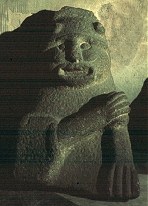
The Belle Hëaulmière must have suffered a decline in fortune, since, according to Villon, she lived with a pimp until his death around 1426. When Villon knew her in the 1450s, she was in her eighties, as decrepit and anguished as The 'Nun' of Beare , the dried-up spring that Rodin portrayed her in bronze
.

This and the previous poem were famously echoed in the 20th century by Bertholdt Brecht, and Georges Brassens made a fine song from the Ballade .


VILLON'S DIALOGUE WITH HIS HEART

Who's there ? It's me. Who's "me" ? Your heart,
that holds on by the merest thread;
I feel my blood ebb and my strength depart
when I see you hanging down your head
like some poor lurcher cringing in a shed.

And why is that ? Because you live too fast.
So what ? It's I who come off worst.
Why, you ask ? I'll think about it. Let me be!
When will you start thinking ? When my childhood's past.
I'll say no more. That's quite all right with me.

What do you want ? To be a man of substance.
You're thirty now. No younger than a mule.
Is that still childhood ? No. Then madness
has got hold of you/
Where ? By the lapel ?
You know nothing. Yes I do: I can tell
the difference between flies and milk. One's white,
one's black. Is that all ? Is that too trite
for you ? I'll start again. Let's see..
You're lost . Well, I'l lput up a fight.
I'll say no more. That's quite all right with me.

From all this I get sorrow, you get pain.
If you had been some poor demented fool
I might have had some reason to complain,
but good and bad you wind from the same spool.
Either your head is filled with wool
or else you want damnation more than bliss.
Well, what is your reply to this ?

I'll be above it when I pass away.
God, how comforting! What wisdom and what eloquence!
I'll say no more.
That's quite all right with me.

Where do your defects come from ? From ill-luck.
When Saturn packed my bag for me
he put them in. What rubbish! You're star-struck.
You are master yet think yourself unfree.
Solomon has written - you can see
it in the Bible
- 'Men of sense
have power over planets and their influence'.

I don't believe it. As they made me, so I'll be.
What did you say ? Just my kind of sense.
I'll say no more . That's quite all right with me.

You want to live ? May God give me the power!
You must then... What ?! Read every hour,
be penitent.
Read what ? Philosophy -
and leave your trivial friends.
I'll see.
Now don't forget. Don't be perverse;
don't wait so long that things get even worse.
I'll say no more.
That's quite all right with me.


Click for ten translated poems by Rimbaud >>