

|
county list
|
| Court-tombs = Portal-tombs = Wedge-tombs = Passage-tombs = Stone Circles | France | |
|
|
|
SELECTED MONUMENTS IN
Place-names in italics refer to listed entries.
Annaghmare: Court-tomb
click on the thumbnail for a larger picture
The most westerly of a group of monuments around the sacred mountain of Slieve Gullion, this ( The Black Castle ) is a very fine, excavated example of a single-court tomb, whose out-of-line, south-facing, horseshoe-shaped court is very well preserved. It is over 8 metres in diameter, with walls of large orthostats alternating with sections of good dry-walling: a typical "post-and-panel" construction. Such a forecourt might well have had special acoustical properties important in ritual. The gallery is 7 metres long, segmented by jambs (one of which has an uncompleted cup-mark) into 3 chambers. Much of the cairn (which is nearly 20 metres long) survives to a height of 1.8 metres. Two lateral chambers at the N end of the cairn were built a little later than the rest of the tomb, and have independent entrances. The siting of the tomb on a rock outcrop is unusual.
Ballykeel: Portal-tomb
A fine "tripod-dolmen" stands at one end of the remnants of a long cairn, 7.2 km SW of Camlough, with a ¾ door-slab between the portal stones, which are about 2 metres high. The slab-capstone (the only one actually to have been replaced on a portal-tomb) is nearly 3 metres long. At the other end of the cairn was a box-like kist-tomb. Parallel with the stone-kerbed long sides of the cairn are 2 straight lines of stones, set in the cairn
~ Just over 4.8 km E by S, in Clonlum is a small round cairn, containing a tomb morphologically intermediate between a portal-tomb and a megalithic kist. A massive (now broken) capstone was originally 2.7 metres long. A door-slab was placed, not between the portal-stones (which are over 2 metres high) but between the side-slabs of the chamber.
3.2 km SW of Newry, and commanding fine views to the E this 3-chambered tomb (built around the middle of the fourth millennium BCE) is entered from a shallow, asymmetrical forecourt of small stones. A few of the corbel-stones supporting the now-vanished roof survive.
Clontygora: Court-tomb
click on the thumbnail for a larger picture
Although somewhat mutilated, this tomb, known as The King's Ring (close to the Border with county Louth) is still very impressive, with most of the forecourt's massive orthostats surviving. Similarly large sidestones delineate what is left of the gallery which has 3 chambers, the first of which has a slipped lintel and a large capstone over 3 metres long partly-supported by corbel-stones. It is unfortunate that a typically charmless bungalow has been built close by, but environmental planning in Ireland is notable for its absence. Scant remains o f another court-tomb, marked by a clump of "fairy thorn" are some 200 metres to the S. These monuments and others were pillaged to build the Newry Canal in the 18th century. The townland name is pronounced "Clinchycora". ~ 5.6 kms NNW is another court-tomb at Ballymacdermot .
Navan 'Fort'
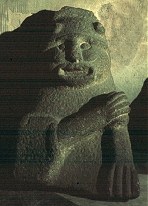
Two kilometres W of Armagh City, this complex and intriguing monument of enclosures, mounds, ditches, the only prehistoric artificial lake in the British Isles, and buried sacred objects - also known as Emhain Macha , and historically the scene of an important annual festival known as Eonach - was excavated over many years, and the results are displayed in a Visitors' Centre. There is also an Official Navan Website . ~ The figure which is the logo of this website, a statue of the Horned-Helmeted god Nuadu of the Silver [artificial] Arm (below left) , was - at least until recently - kept with a miscellany of other figures in the vestry of Armagh (Anglican) Cathedral, where I photographed it.
Slieve Gullion: Passage-tomb
The best part of the visit to this tomb is the spectacular drive through Slieve Gullion Forest Park (open officially in summer only!) to the highest point, from where a signposted track leads up the rest of the legend-rich mountain to the S of the summit ridge. Slieve Gullion is associated with the legendary Ulster hero Cú Chulainn ('Hound of Ulster'), and with that avatar of the Celtic hag-goddess known in Ireland as the
Cailleach Bhéarra
. The passage-tomb is known as "Caillech Birra's House", the nearby dark lake as "Caillech Birra's Lough" - and the Loughcrew passage-tomb complex, to which the passage of this tomb points, is on the Slieve na Calliagh hills, some 60 km away.
|


