
|
county list
|
| Court-tombs = Portal-tombs = Wedge-tombs = Passage-tombs = Stone Circles | France | |
|
|
|
GAZETTEER of
SELECTED MONUMENTS IN
Place-names in italics refer to listed entries.
Aughlish: Stone Circles
Some 200 metres N of a by-road, 5.6 km SSW of Dungiven, in a rushy field above a ruined house and a blasted tree, stands a group of 4 circles, all of many low stones typical of the Mid-Ulster type of stone circle, and stone-rows - one of which extends for 18 metres. This complex is comparable with the much more extensive and better-preserved group at Beaghmore, county Tyrone. ~ 11.2 km WSW is the wedge-tomb at Tireighter .
The megalithic chamber, surrounded by remains of a circular cairn, may be the remains of an imposing wedge-tomb. The court-tomb, on the other side of the road, 200 metres W, is badly ruined, but both forecourts and galleries (on different axes) can be distinguished. Excavation revealed that the tomb was built over a pre-existing ceremonial site whose wooden structures were set on fire.
About 150 metres S of the court-tomb (W of the road) are the remains of a small wedge-tomb whose chamber is about 3.5 metres long by 1.2 wide and 1 metre high. ~ About 2 km NE in Corick , 400 metres S of Corick clachan or house-cluster, are some 5 circles (one with a large standing-stone in the middle) and 3 tall stone-rows
Ballygroll: Stone circles, cairns and tombs
On the slope of a hill 6.5 km N by W of Claudy, and 800 metres E of a by-road, approachable via a farm lane, are scattered at least 12 small round cairns and 6 stone circles (averaging 6 metres in diameter) which may be the remains of cairns. There are also at least 2 ruined wedge-tombs and a court-tomb with a V-shaped forecourt.
Carnalridge: Standing-stone '
The White Wife
'
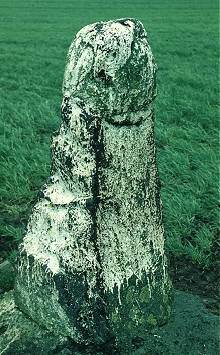
Visible against the sky in a field to the left of a farm lane, 2.4 km SSW of Portrush, this standing-stone is more impressive than its height of just 120 cms would suggest. Known as The White Wife , its shape changes as you walk around it: from one side it is very phallic, while from another it looks like a hunched human figure. A small round stone (now cemented) was always on top of it (an ancient tradition). The stone below was whitewashed so that the unpainted stone looked like a head poking out of a white robe, hence its popular name. The whitewashing of stones (especially phallic stones - and of course the traditional phallic Ulster gateposts) is obviously deeply-symbolic.
Carrick East: Megalithic tomb
In a field to the E of a by-road 6.4 km SW of Limavady, this "anomalous" and beautiful megalith resembles a small centre-court tomb, except that the central court (some 3 metres in diameter) gives no access to the chambers, which still retain their capstones.
Cregg: Standing-stone
Approached by a leafy lane, this standing stone (100 metres N of the road to Derry City) is a magnificent quartz boulder some 1.8 metres high, beautifully patterned by crevices, natural straining and lichens. Not surprisingly, it is known as The White Stone .
~ 5.6 km ESE in Clagan , 400 metres SE of Clagan Bridge, are 3 prominent standing-stones, which were overturned by treasure-seekers in 1770. Two have been re-erected (one askew) but the third and largest (3.6 metres long) remains prostrate. The field they are in is littered with white quartzite pebbles, and the site commands wide views. ~ Almost 9 km SE of the Cregg stone are Loughash wedge-tomb and stone circle, county Tyrone. ~ 14.8 km WSW of the Cregg stone, in county Tyrone, is a pair of standing-stones at Sandville (C 388 048),to the S of a by-road and less than 400 metres NNW of Milltown Burndennet. One is 2.1 metres high and pointed, while the other is a little lower and has a grooved flat top. These stones, only 75 cms apart on either side of a boundary fence, seem more likely to represent male and female, like other pairs in Ireland (notably Boherboy ), than to be the portals of a vanished tomb. In this case it is likely than heifers and cows were driven between them, one by one, to ensure their fertility.
Knockoneill: Court-tomb
To the N of a by-road, up a short track and across a field, 4 km WNW of Swatragh, this well-preserved tomb has a forecourt 7 metres in diameter, leading into a 2-chambered gallery with a small antechamber formed by doubling the entrance-orthostats (door-jambs). The backstone of the gallery is also a wall-stone of a small subsidiary chamber which is entered from the SE kerb via a passage almost 1 metre wide. The forecourt is closed by a line of orthostats opposite the entrance, giving it the appearance of a full-court tomb. But excavation showed these to be a later feature, for the forecourt was used for Bronze Age burials, and the whole tomb was re-covered with a circular Bronze Age round cairn. ~ 2.4 km NE, in Tamnyrankin (C 836 100) is an even better-preserved tomb whose 12-metre long cairn survives to a height of 2.4 metres. Behind the 2-chambered gallery a subsidiary chamber stretches across the width of the cairn. It is divided in two by a sill-stone. Some of the corbels of the gallery are still in place.
Moneydig: Passage-tomb
In a field to the W of Moneydig crossroads, this small, "degenerate", passageless passage-tomb known as The Daff (=black) Stone is still covered with small cairn-stones and soil to a height of 1.5 metres. The chamber is covered with a single large capstone and is walled by tall slabs fitting very neatly together. A low slab on the NE side marks the entrance.
Tireighter: Wedge-tomb
In a field to the right of a farm lane leading E from a by-road, about 800 metres S of the hamlet of Park, this fine tomb (The Chieftain's Grave) was only just saved from demolition some 40 years ago: only the back end was damaged. It has an imposing façade (5 metres wide) of well-matched orthostats, the two outside ones just 1.5 metres tall. Some typical double-walling survives. The entrance has a typical sill-stone and leads into an antechamber or portico and on, across a septal slab (a high sill-stone) into the large main chamber, in the back of which lies a massive displaced roofstone. Both chamber and portico are partly-filled with cairn material including some white quartzite pebbles associated with many Irish prehistoric tombs.
~ 3.6 km NNW, 400 metres SE of Clagan Bridge, are 3 prominent standing-stones, which were overturned by treasure-seekers in 1770. Two have been re-erected (one askew) but the third and largest (3.6 metres long) remains prostrate. The field they are in is littered with white quartzite pebbles, and the site commands wide views. ~ Some 13 kms W by are Loughash wedge-tomb and stone circle, county Tyrone .
Tirnony
or
Tirnoney: Portal-tomb
Click on the thumbnail for a larger picture
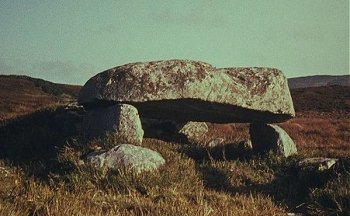
By the side of a road leading NE from Maghera to Killelagh Lough and Carntogher hill, this charming dolmen is remarkable for the free-standing orthostat, 1.8 metres high, which is beside one of the portal-stones. This suggests a derivation from the much longer court-tombs. The picturesque capstone tilts at the usual angle, and behind it is a well-defined square chamber. |