
|
county list
|
| Court-tombs = Portal-tombs = Wedge-tombs = Passage-tombs = Stone Circles | France | |
|
|
Tell-A-Friend
|
SELECTED MONUMENTS IN
Place-names in italics refer to listed entries.
Ballyganner South: Burren Wedge-tomb
cl;ick on the thumbnail for a larger picture
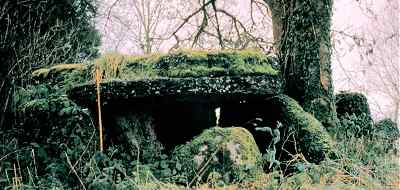
Situated 1.5 km NW of the prominent Leamaneh Castle, this fine but damaged tomb has the largest chamber in the Burren, formed by 2 great sidestones over 5 metres long and a neatly-fitting backstone. The top of the S sidestone juts forward like a prow and bears definite traces of dressing. The front (W) end of the chamber is partly closed by a large slab which leaves a gap at the N side. Over the W end of the tomb are two broken slabs which, together with fragments inside and outside the chamber, formed the huge roof of the tomb. In 1955 a large bonfire was lit on the intact roofstone to celebrate a Hurling victory.
~ There is another wedge-tomb in the same townland, 2.4 km to the NNE, with a roofstone 4 metres long. Stretching N towards Ballyganner Hill are various other tombs, including a court-tomb in Ballyganner North (R 219 956), and, in Noughaval (R 213 966), a stone fort or cashel known as 'Cahercutteen', with exceptionally large stones and a fine flight of steps giving access to the cashel wall . ~ 1 km due E in Clooneen is another large wedge-tomb with a huge capstone and in a good state of repair.
Ballykinvarga: Stone fort
A fine and large stone fort measuring 49 by 39 metres internally, and built of large limestone blocks, it has a fine chevaux-de-frise of closely-spaced upright stones to impede attack, including a larger standing-stone (part of a destroyed megalith ?). It is 1.6 km ENE of Kilfenora. The wall, surviving up to 4.5 metres high is typically built in vertical layers so that it is as much as 6 metres thick in parts. Remains of huts can be seen built against the wall inside.
Baur South
: Burren wedge-tomb
About 8 km WSW of Ballyvaughan, on the edge of a craggy plateau and just visible from a tarred track, this fine well-preserved wedge-tomb is built typically of thin Burren slabs and contains, unusually, a chamber within a chamber 2.4 metres long, both sharing the same backstone, and retaining its roofstones. As at Poulaphuca (2.5 km NE) the E endstone has a corner chipped off.
~ 5.6 km S by E is the large but damaged tomb at Ballyganner South. ~ 1.2 km W by N is a fine stone fort at Cahermacnaghten , containing foundations of rectangular stone buildings. ~ 2 km ESE is another stone fort at Caherconnell , in use until (or reused in) the 15 th century.
Caheraphuca: Burren wedge-tomb
800 metres SW of Crusheen, this tomb is not very attractive (a stone wall has been built against it) but is included because of its accessibility. It displays the characteristic wedge-shape of these tombs. A long chamber of 5 stones supports 2 roofstones. ~ 10 kms NE is Derrycallan North wedge-tomb, county Galway.
Caherdooneerish: Stone fort
At a height of about 210 metres above Black Head this fort is worth the climb up from the coast road for the Burren flora and the view over Galway Bay alone. The fort is built on a level piece of limestone karst and is roughly D-shaped. There is a terrace and traces of stairs. It is about 20 metres in diameter with jointed walls over 4 metres high and almost as thick in places. The stonework - of beautiful fissured Burren limestone - is better on the N and E sides than on the S and W, which, together with the irregularity of shape, suggests unskilful rebuilding at various times.
Derrynavaha
: Burren wedge-tomb
click on the thumbnail for a larger picture
Situated about 8 km WNW of Lisdoonvarna, this tomb, together with that at Baur South, is one of the finest of many wedge-tombs in the Burren of Clare - and the flora surrounding it, and the superb view S over the remarkable limestone pavement (or karst) as far as the mountains of county Kerry (on a good day) add to its appeal. The chamber, which is about 3.4 metres long is covered at the W end by a large, broken, grass-covered roofstone measuring 2.1 by 2.4 metres. Some of the stones of the characteristic outer wall are higher than the roof. The E end is closed, and the entrance at the W end is partly closed by a high slab at right angles to the chamber.
Magh Adhair: Inauguration site
Placed unusually in an amphitheatre of low hills, this site, traditionally the Inauguration Place of the kings of Thomond has the usual features (like Tara ) of large mound and other earthworks in a place of older antiquity marked by megaliths. To the N of the large mound over 6 metres high is a large stone with a bullaun in it, and to the W of the mound is a cairn over 3 metres high. These features are partly enclosed by an earthen bank on the E in which stand many stones, and partly enclosed on the SW bvy a stream in which is a two-metre high Standing-stone. Close by this site there were great gatherings down to the time of the Great Famine. ~ About 500 metres SSW is Cahercalla large trivallate (triple-banked) stone fort known as Cahercalla.
Moghane or Moughaun: Stone fort
Located in the grounds of Drumoland Castle, 1.2 km NNE of Newmarket-on-Fergus, this trivallate fort, commanding extensive views over the Shannon Estuary, covering an area of over 10 hectares, is believed to be the largest hill-fort in the country. At the highest point is the inner cashel or citadel with walls over 3 metres thick and a diameter of over 100 metres.
Newgrove: Wedge-tomb
Only 1.6 kms W by N of Tulla, by a hedge in a field to the left of a lane leading to Newgrove House, this small wedge-tomb retains its roof, most of its outer-walling, and some of its circular cairn. Four mossy stones NW of the chamber may be the remains of a kerb. The roofstone is chocked by a small boulder resting on the N corner of the closing-slab at the W end of the tomb. A loose block of sandstone lying at the E end of the chamber with a round depression 27 cms in diameter and 9 cms deep may be a bullaun.
Parknabinnia
: Burren wedge-tomb
2 km NNW of Killinaboy, this is one of the more accessible tombs in the dramatic landscape of the Burren, close to a by-road, remains of its cairn survive. The roofstone is over 3 metres long and now growing a crop of grass. The sides are formed of single massive slabs. The E (rear) end is closed and the front is partly closed. There are several tombs in the townland, at least one of which is very similar.
Poulaphuca: Burren Wedge-tomb
About 6.5 km SW of Ballyvaughan., this tomb has a very neat box-like chamber, closed at the E end by a slab reaching to the roofstone which rests on 2 long sidestones and the backstone. Two grassy cairns lie to the NE. As at Baur South, the E endstone has a corner chipped away.
Poulnabrone: Portal-tomb
Next to the carved stones at Newgrange, this is the most-photographed megalith in Ireland. It is a fine tomb set on the limestone pavement to the E of the road from Killinaboy to Ballyvaughan, in the centre of a low round cairn. The entrance faces N and is marked by a low sill-stone. The thin roofslab,lifted to a height of 1.8 metres by imposing slab-like portal-stones, is tilted at the usual portal-tomb angle.
~ 1 km NNE is Cahercashlaun cliff-fort, a roughly-oval 'cashel' containing a souterrain, and an outer defensive wall on the NE side. The entrance is a natural cleft in the limestone, and was originally roofed with slabs. ~ 1.6 km NNW is a wedge-tomb in Gleninsheen - a small, box-like tomb resembling a stone kist whose E end is now open. Remains of two other wedge-tombs stand nearby. |