
|
county list
|
| Court-tombs = Portal-tombs = Wedge-tombs = Passage-tombs = Stone Circles | France | |
|
|
Tell-A-Friend
|
GAZETTEER of
SELECTED MONUMENTS IN
Place-names in italics refer to listed entries.
Ballynacloghy: Portal-tomb
Near the shore at the head of Lackanaloy Creek, 8 km SW of Oranmore, this little-known tomb partly collapsed when one of the orthostats shifted and fell.
Crannagh: Portal-tomb M 426 058 Sheet 52
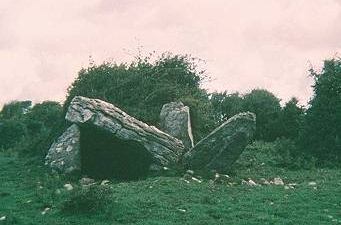
Visible from a lane running E from a by-road, opposite Caherglassaun Lough, this very picturesque
Dermot and Grania's Bed
is probably best viewed from afar. It is sited on a stretch of Burren-type limestone, at the NNE end of a cairn some 22 metres long. Two tall portal-stones and a backstone precariously support a tilted capstone 3.5 metres long.
~ 800 metres S in Ballynastaig , is a wedge-tomb roofed with a single massive stone. ~ 400 metres W, to the N of the lane approaching Crannagh dolmen is Ballynastaig stone fort. In it are a wall-chamber and a lintelled passage with steps which may have been a well, or a flooded souterrain. ~ 11 kms SSW, on the W side of the road 400 metres S of Ballynakill Lough, is Derrycallan North "Dermot and Grania's Bed": a small wedge-tomb with trees growing out of it. A small chamber closed at both ends is covered by a single roof-slab over 3 metres long. The S side also of the tomb consists of a single slab over 2.5 metres long. Part of the cairn survives
Derryinver: Stone-row (alignment)
|
|
click here for a high-resolution picture
|
~ 8.8 kms WSW in Cleggan , picturesquely sited on the N shore of Cleggan Bay, beside a low cliff just 9 metres above the sea, is a court-tomb whose court no longer survives, but whose fine three-chambered gallery retains a large roofstone over 3 metres long over the second chamber, resting on what may be a displaced lintel-stone.
This is the most famous of the stone forts on the Aran Islands in Galway Bay (boats from Galway town and other ports in Galway Bay, depending on the season). Although over-restored, it is a magnificent structure perched on top of a sheer 60-metre cliff,

with two rows of semicircular defences and a very fine "chevaux-de-frise" of thousands of sharp pieces of limestone set upright to impede access. A fourth (outermost) wall is almost destroyed. A low-lintelled doorway leads in from the N. The innermost citadel (whose massive buttresses are modern) has a fine lintelled entrance, wall-walks, and chambers, and encloses an area roughly 45 metres across.
~ 2.2 km NW of Kilronan is Dun Oghil ( Dún Eochla , L 863 098), another massive (and over-restored) fort, circular and surrounded by the tiny stonewalled fields that are typical of the West of Ireland. Piles of stones inside the citadel are the remains of huts, and there are terraces and stairways.
~ 7.4 km WNW of Kilronan is Dun Onaght (Dún Eoghanacht) , an almost circular, single-wall fort with terraced rampart and three house-sites.
~ 2.2 km SW of Kilronan is Dun Doocaher ( Dún Dubhchathair or the Black Fort), a promontory fort with remains of chevaux-de-frise outside a massive curved rampart cutting across the base of a cliff-girt promontory.
~ 3.5 km WNW of Kilronan, in Oghil is Dermot and Grania's Bed (Leaba Dhiarmuid agus Gráinne), a fine wedge-tomb with three overlapping roofstones covering a gallery over 2.5 metres long.
~ On the middle island of the Aran group, Inishmaan , is Doon Conor (Dún Chonchúir) ,

also over-restored but very impressive, with terraces, wall-chambers and (restored) hut-sites.
In a field beside a house, up a lane to the N of a by-road, 6 km NE of Loughrea, this remarkable phallic pillar was moved from the Rath (Iron Age farmstead) of Feerwore ( Fír Mhór: Big - or Great - Men) in the same townland, where excavations suggested that an open site dating to the last centuries before the Christian Era was later enclosed. The stone is of granite, 90 cms high, and the top half is covered with a continuous abstract curvilinear design carved in relief in the Celtic style known as "La Tène", with a kind of circumcision-line of Greek-key pattern beneath it. The flowing design can easily be interpreted as semen. It is amazing that such a wonderful object - resembling (and obviously as important as) the Navel Stone at Delphi, has survived in Ireland up to the 21st century, remaining outdoors, albeit somewhat spoiled by a concrete surround and cattle-grid.

It has a kind of "sister" in the egg-shaped
Castlestrange
Stone, county Roscommon.
|
click here for high-resolution pictures
|