
|
county list
|
| Court-tombs = Portal-tombs = Wedge-tombs = Passage-tombs = Stone Circles | France | |
|
|
|
GAZETTEER of
SELECTED MONUMENTS IN
Place-names in italics refer to listed entries.
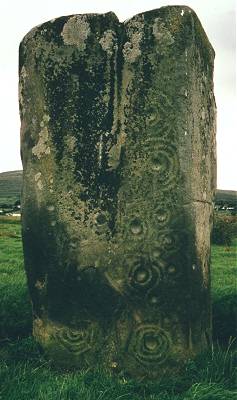
Ardmore: Decorated standing-stone C 473 264 Sheet 7 In a field 1.6 km NNE of the village of Muff, stands a rectangular block 2.1 metres high, and decorated on the S face with around 40 cupmarks of which about half are surrounded by 1, 2 and 3 worn rings.
Barnes Lower: Decorated standing-stones
Two massive standing-stones under a metre apart stand immediately E of a by-road leading towards Crockmore. The larger one, a massive slab over 1.8 metres square, has many cup-marks (some with large rings) and wide, shallow grooves on its E face. The smaller one, shaped like a spearhead, has cupmarks and a cross (a relic of Penal times ?) on its W face. Both faces are lit simultaneously in late morning.
~ In the same townland (C 122 263), on high ground overlooking Lough Salt, is a three-stone row whose highest stone is 1.2 metres. ~ 400 metres N of the stones is an interesting but overgrown court-tomb with long lateral galleries set transversely to the main gallery.
~ 7.2 km SE in
Letter
"The Labba Rocks" (C 165 197) are a court-tomb in a wedge-shaped cairn, sited near the top of a hill and affording fine views. Many kerbstones survive, and roofstones are strewn about.
Carnaghan: Portal-tomb
400 metres W of a road-junction on the former island of Inch, the portal-stones of this tomb-among-the-trees are very impressive at over 2.5 metres high - although the roofstone is gone. Behind these is a large, secondary kist-chamber about 1 metre deep, covered by a capstone 2.4 by 1.8 metres which sits on several variously-sized chocking-stones. A couple of side-stones (one fallen) and some of the cairn (greatly reduced by ploughing) survive.
Drumboghill: Stone fort
(Doon Fort)
and crannóg
click on the thumbnail for a larger picture
Set in superb landscape and in the middle of Doon Lough (boats can sometimes be hired), one of many thousands of Irish crannógs (small artificial island-refuges) has sprouted an impressive stone fort, partly-restored. It is terraced with steps on the inside and has wall-passages which may be original. The walls (3.6 metres thick at the base) stand to 4.5 metres high. From the mainland a fine view can be obtained of the S side of the fort and its damaged entrance. It is also known as O'Boyle's Fort, and The Bawan. ~ About 800 metres WNW on an island in Lough Birrog, up a stone-flagged causeway leading from the shore, is another (ruined) stone fort.
Farranmacbride: Centre-court tomb
Glencolumbcille is famous for its
turas
, or devotional
pattern
on the 9th of June, along a given route which is punctuated by stations. Most of the stations feature beautiful early-christian cross-slabs and cairns, but two are in fact megalithic tombs. The one in Farranmacbride (the ninth station, 400 metres N of the church of Glencolumbcille), close to a perforated standing-stone "through which Heaven may be glimpsed" by the pure - or devout - "and barren women made fertile", is a huge ruined court-tomb, some of whose chambers have been used as livestock pens.
~ 4 km NE in Malin More are a large full-court tomb known as "Cloghanmore" (G 518 826) - over-restored after being pillaged as a quarry - and, 1 km to the W, several portal-tombs (G 502 825) in a line, which may all have been covered by one enormous cairn. The court-tomb has parallel twin double-chambered galleries opening on to the large oval court which is marked partly by orthostats and partly by dry-walling, indicating 'development' from an open forecourt to a full-court. From it 2 single chambers open into the 'arms' of the court; at each is a flanking orthostat set in the wall of the court and bearing curvilinear ornament in the style of passage-tomb art - the only example known in a court-tomb.
Gortnavern: Portal-tomb
click on the thumbnail for a larger picture
Dermot and Grania were two illicit lovers who eloped and slept in a different wild place every night. This picturesque " Dermot and Grania's Bed" has a chamber of 5 slabs set on edge (one fallen), and covered by a slipped (and characteristically tilted) roofstone 3.6 metres long, which is raised 2 metres off the ground by the portal-stones. There are 5 cupmarks on the upper surface.
Grianán of Ailech: Stone fort
Unfortunately over-restored in the last century, this fine fort (also known as The Greenan , and Grianán Ailighe ) offers magnificent views of Loughs Foyle and Swilly and the countryside round about from its position on top of Greenan Mountain. This is one of several monuments to be (latterly at any rate) associated with the sun ( Grian in Irish). Around the imposing stone wall (up to 4.5 metres thick and 5 metres high) are the remains of 3 earthworks which presumably pre-date the fort, which may have been built as late as the 6th century. The walls were only 1.8 metres high before enthusiastic restoration was carried out; there were originally 2, not 4, stairways, and the terracing is obviously wrongly reconstructed. There are 2 wall-galleries entered from within the fort, which was the seat of the O'Neill sept of Aileach from maybe the 5th to the 12th century, and is mentioned in the Annals of Ulster as late as 1100 C.E.
~ 6.4 km NW are Carnaghan portal-tombs.
Kilclooney More: Portal-tombs
click on the thumbnail for larger pictures
Approached via a grassy lane behind Kilclooney Church, the larger of the two portal-tombs changes shape as you go round it: now a Mexican hat on legs, now a wingless bird or Concorde aircraft. Portal-stones 1.8 metres high support a massive roofstone 6 metres across. Between the backstone and the roofstone is a fine example of a chocking-stone set to get the characteristic angle of tilt just right. The small tomb, at the other end of the remains of a long cairn, still has 2 sidestones, an inset backstone and one portal-stone, and is roofed with a horizontal slab. Both tombs have low sillstones at the entrance to E-facing chambers.
~ 350 metres W by N, 60 metres E of the road, is a court-tomb with corbelling on part of the S side, and one of 2 displaced lintels still spanning the gallery. ~ About 750 metres SSE, 240 metres S of Lough Nacroaghy, is another small, roofed portal-tomb. ~ 8.8 km NE in Toome , close to the N tip of Toome Lough is "Dermot and Grania's Bed" (B 791 015), a long cairn overgrown with ivy and honeysuckle and incorporating 2 portal-tombs, 10 metres apart. The larger of these faces E into the cairn and has portal-stones 2 metres high flanking a door-stone 1.2 metres high. The slipped capstone is partly supported by exterior corbels outside the low sidestones. The backstone is gabled: a feature of many court-tombs. The roofstone and doorstone are of limestone, while the rest are of granite. The other tomb also faces E, is more ruinous, but has massive sidestones.
Magheranaul: Wedge-tomb, Standing-stone and rock-scribings (petroglyphs)
Just over 100 metres N of a by-road running E towards Malin, this interesting "Giant's House" - more suitable for a hardy dwarf than a giant - has a grass-covered, wedge-shaped roofstone over 2.5 metres long and 1.2 metres wide, covering a long, low wedge-shaped chamber bounded by 2 long sidestones, a backstone, and a massive single door-stone pierced by a hole 15 cms in diameter and 18 cms deep, obviously cut from both sides of the slab. "When there was thunder and lightning, the giant (or ogre or dwarf) went in, put his finger through the hole and pulled the door to." It seems unlikely that there was a portico or antechamber in front of the door-slab. ~ 1200 metres SSE, near the shore (C 433 495) is a standing-stone 1.4 metres high. ~ In the next field W of the standing-stone (C 426 500) are four separate rock-surfaces decorated with cups and rings, parallel grooves, cups and gapped-rings with radial grooves, and 'cartouche' motifs.
click on the thumbnail for a larger picture

~ About 1000 metres WNW of the wedge-tomb, to the right of a lane (C 416 506 in the townland of Carrowreagh or Craignacally) is "The Altar" or "Mass Rock", a semi-circular thin slab whose SE face is covered in deeply-incised cross-motifs, which some think to be prehistoric reworkings of existing fissures deepened by weathering. This stone used to be near the petroglyphs mentioned above, but was transported in the iniquitous 'Penal' times to be used as a Mass Rock for the practice of illegal "Papist" rites which could earn the devout a horrible voyage to Australia.
~ 5.2 km SW, at Cloontagh (C 397 455) is "Cloghtogle", a curious boulder over 2 metres high and over 3 metres square is supported on small chocking stones at two points and on bedrock at a third.
Muntermellan: Portal-tomb
click on the thumbnail for a larger picture
Tucked between two rocky ridges overlooking Dunfanaghy, with a fine view across to Errigal and Muckish mountains, about 400 m NW of a by-road leading towards Croaghamaddy Hill at the point where it leaves the water's edge and climbs the hill, this tomb retains a good deal of its cairn. It is also known as
The Dane's Cove
, and
Diarmuid/Dermot and Grania's Bed
. Between the two tall portal-stones (2.5 metres high) is a doorstone which closes the chamber. The sides and back are formed by single slabs - one over 3 metres long. One of two roofstones - a table-like horizontal slab rests on 2 corbels (one displaced) on each sidestone. The other, slightly larger roofstone has been displaced and now leans against the W portal-stone.
Shalwy and Croaghbeg: Full-court tombs
Two very fine court-tombs stand close together in adjacent townlands, about 300 metres W of a road junction. Both have fine megalithic lintelled portals and two-chambered galleries. Much of the cairns survives. The Shalwy tomb ( Muinner Carn ) is well-enough preserved to show careful construction with good joints between the portal-stones and sidestones, so that the chambers of the gallery is not unlike a small ruined stone house of recent date. In the front chamber lies the prostrate door-slab. The lintel is double, and the top stone is gabled. The gallery is roofed by large slabs resting on corbels.
To the SW,
The Portabane Carn
in Croaghbeg has a fine court of handsome orthostats set close together and decreasing in height towards the extremities. The gallery is also impressive, with massive back-and side-stone corbels, lintels and jambs. On the N side of the court is a single subsidiary chamber with jambs and backstone, and, as in the gallery, sill-stones between the jambs. An interesting feature of the court is the double coursing of the stones nearest the entrance, matching the height of the impressive lintel. The tomb is a fine experiment in the development of Irish court-tombs. From Croaghbeg there is a fine view S over Donegal Bay to King's Mountain, Ben Bulben, Knocknarea: an area of county Sligo rich in megaliths as well as Yeatsiana.
Tawlaght: Court-tomb
Standing 400 metres E of Lough Nashannagh, the two-chambered tomb has a fine lintel (with a small chocking-stone) over the low entrance, and some large slab-like corbels survive. Only one court-stone can be seen; others may be buried in the cairn-spill which half-fills the court area. The tomb was intact at the beginning of the 20th century, but, as with so many megalithic tombs, the stones were wantonly removed by hunters of small mammals. (This of course also happened in France during the second World War, when the Resistance maquisards were in hiding and hungry.) The nearest source of stone for the tomb is nearly 2 km SE. ~ 8.8 km E by S, in county Fermanagh, is Drumskinny stone circle and alignment.
Tops: Stone Circle and Round Cairn
Approached via a farm lane leading W from a by-road running due S from Raphoe, this fine early circle (perhaps contemporaneous with, or a little earlier than, Ballynoe , Down) of 60 surviving stones averaging 1.6 metres in height is the kerb of a much reduced cairn, and similar to kerbed boulder-circles at Carrowmore in Sligo. Also known as Beltany , it is prominently sited on a hilltop, and affords wide views. Well outside the ring to the SE is a tall outlier. From the high pillarstone at the WSW of the circle a cupmarked triangular slab at the ENE marks the point where the sun rises on May Day (Bealtaine or 'Beltany').
Twomilestone: Standing-stone and stone forts (cashels)
Situated on the Two Mile Ridge beside a track (neither track nor monuments are marked on the map), a leaning monolith some 2.5 metres high may be associated (but not necessarily contemporaneous) with remains of ancient field-walls, stone walls, low mounds of stones etc. A cashel (probably an ancient cattle-enclosure) is incorporated in the field-system, and there is another one (perhaps a fortified farm) not far away. (The word cashel derives from the same Latin word as castle .) In a marshy hollow to the E is a pair of small standing-stones, one flat-topped and one pointed: female and male. This site seems to have been in use from at least Bronze Age to mediæval times. |