
|
county list
|
| Court-tombs = Portal-tombs = Wedge-tombs = Passage-tombs = Stone Circles | France | |
|
|
|
SELECTED MONUMENTS IN
Place-names in italics refer to listed entries.
Burren: Wedge-tombs
click on the thumbnail for a larger picture
Approached from a track running S from Tullygobban Lough into dreary conifer plantation, "The Giant's Grave" is a fine, large and well-preserved example with a gallery over 7 metres long, divided by a high septal slab into a long portico and a large main chamber. The gallery is covered by 5 roofstones, 3 of which cover the main chamber, and one of which has chock-stones. The front capstone has a series of depressions which may be artificial cup-marks. Two of the front orthostats of the façade lean together to form a triangular entrance to the antechamber. The septal slab has a gap at the bottom of the N end which seems artificial.
NOTE : ' Burren' comes from the Irish for a stony place, and is a not-uncommon place-name. This tomb is not in THE Burren of county Clare, where there are dozens of typical Irish wedge-tombs. ~ The stones visible on the skyline to the S of the wedge-tomb are the remains of the forecourt of a court-tomb in Legalough . Beyond this again is another wedge-tomb, more typically Irish than that of Burren. ~ 2.4 km ENE, in county Fermanagh is Clyhannagh single-court tomb whose gallery is distinctly kinked - suggesting that a two-chambered megalithic kist was enlarged by the addition of two more chambers and a forecourt. ~ 5.6 km NNW, also in county Fermanagh, on the other side of Lough Macnean Upper, 500 metres N of the Belcoo-Garrison road (H 062 401) is Kilrooskagh portal-tomb, which must have been spectacular before its 3 x 2.4 metre capstone collapsed. Only three other stones survive.
Cohaw: Double-court tomb
A good example of a double- (or dual-) court tomb, 5.6 km ESE of Cootehill, built as two single-court tombs back-to-back, standing in a rectangular cairn 25 metres long. Each semicircular forecourt (N and S) leads into a 2-chambered gallery with sill-stones and jambs. A fifth chamber has been contrived in the space between the ends of each gallery. Stone pegs in the forecourts mark post-holes, suggesting an awning over the ceremonial spaces.
Drumhawnagh: Portal-tomb
6.4 km SSW of Ballinagh (Bellanalagh), a small breeze-block shed has been built right beside this tomb, which is a polygonal chamber covered by a single capstone almost 2 metres square. It is not in its originalposition, having slipped when a sidestone was removed in the twentieth century to free a trapped bullock. The sidestone was replaced on instructions from the parish priest, but commitment did not extend to the effort required to re-instate the slipped castone. More recently, a calf got trapped in the fine portal-tomb at Aghawee, 8.4 km to the E, and the large capstone, already split in two, was thrown down beside the tomb to free the trapped beast. In Ireland, the bovine is almost divine. ~ Less than 800 metres to the W, behind a house on the E side of a by-road, in Middletown , is another "Druid's Altar" with a capstone 1.7 metres long and portal stones the usual 1.8 metres high. It is, however, partly obscured by bushes and littered around, as much of Ireland, by domestic refuse.
3.2 km ENE of Kilnaleck, 90 metres totheS of a by-road leading to Ballyjamesduff, this tomb is impressive despite partial wrecking. The large capostone is nearly 2.4 metres long, and has tipped into the chamber. One of the sidestones has collapsed, and one of the portal-stones is missing. The remaining portal-stone is the usual 1.8 metres high, and the door-slab is still in position.
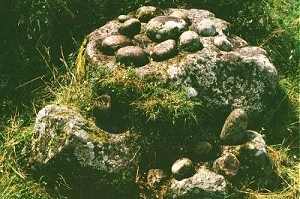
Close to the shore of Lough Macnean to the N of the road to Sligo, this site may well go back to pre-Neolithic times. Not far from the ruins of a megalithic tomb known as "St Brigid's House", and beyond the modern graveyard, is a large boulder ("St Brigid's Stone") with 2 smaller ones containing 16 hemispherical depressions known as 'bullauns' (hollows), measuring from 15 to 30 cms in diameter, and each holding a smooth rounded or oval quartzite pebble or pestle. These stones are known as "cursing-stones" though they might just as well be "curing-stones". In recent folklore, the stones were turned anti-clockwise while a spell or a curse was put upon someone - but if there was no just cause the curse would rebound upon the curser. The original ritual or ceremonial function of such stones will probably never be known. They are aways associated with Christian sites, though obviously pre-date them - as of course do Holy Wells.
Moneygashel: Stone forts
The largest of 3 stone forts (cashels) in the townland is nearly 800 metres N of a former schoolhouse, and best approached through a farm 400 metres further on, and up a lane. It has a well-preserved lintelled entrance and unusual external stone stairs. Inside are two other stairways. The wall survives up to 3 metres and encloses an area 25 metres in diameter. 450 metres SW, on a rise, is a smaller ruined cashel with a fine, corbelled free-standing Sweathouse just inside the entrance.
|