
|
county list
|
| Court-tombs = Portal-tombs = Wedge-tombs = Passage-tombs = Stone Circles | France | |
|
|
|
SELECTED MONUMENTS IN
Place-names in italics refer to listed entries.
Aghanaglack: Double-court tomb
Approached by a motorable track through a forestry plantation, this impressive tomb has been used (like much of the Irish countryside) as a rubbish-dump in the past. Two twin-chambered galleries about 6 metres long share a common backstone. The NE court is horseshoe-shaped and set askew to point E.
Boa Island (Dreenan): Statues
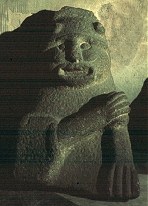
Boa Island is no longer an island, and the two famous statues are in Caldragh old graveyard in the townland of Dreenan, nearly 10 km E by S of Kesh. The more famous of the statues (marked Carved Stones on the map), is a double-sided figure of two beings in typical 'Celtic' squatting mode, carved back-to-back, the E side being male with a pointed penis beneath the stylised crossed arms (all carved in high relief), and the W side being female, with a protruding tongue. There is incised zig-zag decoration between the two heads, which may represent hair, and both figures have a band or belt at the base of the torsos.
The other, smaller, statue came from Lusty More Island close by, and was perversely known as "The Lusty Man" even though it is genderless. The fact that only one eye is fully carved suggests that it may represent the Badhbha or Divine Hag, who latterly became the Caillech Bhéarra , and, like the Norse sky-god Odin, was blind in the left eye. The name Boa is an anglicisation of her name. This statue is carved in light relief, and the figure seems to be holding something. The protruding tongue of this figure and the W side of the larger statue is a symbol of divinity (cf also the Greek Gorgons) also associated with Odin, and in mediæval times became a symbol of concupiscence or lust. These figures are part of a vast iconographic web and provide the archæological and 'Celtic' fringe with plenty of opportunitiues for selective interpretation. The date of the statues is probably no earlier than the 8th century (and maybe rather later). It is remarkable that they should have survived even in this formerly most remote part of Ireland, especially since the other famous Fermanagh figures on White Island, to the S, are so evidently Christian. They have not, like many other Irish monuments, been vaguely Christianised with fanciful saints' names. ~ 14.5 km SE are other carved stones at Killadeas . ~ 10.4 km N by E is the court-tomb at Tawlaght , county Donegal. ~ 14.4 km NE is Drumskinny stone circle and row.
Breagho: Megalithic tomb ?
On top of a low hill, commanding fine views, and formerly thought to be a ruined stone circle, this picturesque group of 7 stones (ranging from 75 cms to over 2 metres high) is more likely the remains of a megalithc tomb. ~ 5 km ENE at Ballyreagh , less than 800 metres SW of Lough Mulshane, is a double-court tomb (H 313 506) whose 33-metre cairn encloses 2 twin-chambered galleries featuring sill-stones and septal slabs. A house was once built against the N wall of the E gallery. ~ 8 km ESE at Pubble , just 1.2 kms SW of Tempo, on the top of a low hill cut through by the road to Lisbellaw (H 346468) are "The Doon Stones", two stones placed one on top of the other, with Bronze Age designs on contiguous faces. The upper face of the lower stone, which is 1.1 metres high and 1.8 metres long, bears many cup-marks, and has a large cup-mark on each of its other 3 sides. The lower face of the upper stone (1.5 metres long) has a design of spirals and a circle.
Drumskinny: Stone circle and stone-row
There are many examples of stone circles in high bogland in N Fermanagh, S Derry and Tyrone, but this is one of the most charming and accessible. Measuring 13 metres in diameter, it originally had 39 upright stones up to 1.8 metres in height, with a probable gap to the NW where there is a small carefully-constructed cairn of stones contained within a kerb almost 4 metres in diameter. Stretching S from the cairn is a 15-metre-long alignment of 23 small stones. ~ 5.6 km ENE, in county Tyrone, is a court-tomb at Ally , signposted from a car-park by the main road in Lough Bradan Forest. An enormous lintel sits on top of the entry jambs, whose forecourt and entrance are obscured by the modern circular wall of a sheepfold. There are 2 chambers, and beyond them a lateral chamber with gabled backstone, corbel stones and displaced roofstone. ~ 8.8 km W by N, in county Donegal, is Tawlaght court-tomb (H 113 724) some 400 metres E by S of Lough Nashannagh. with a fine lintel spanning the low entrance to the two-chambered gallery. This tomb was intact at the end of the 19th century, but like perhaps scores of Irish prehistoric tombs it was ransacked by "sporting" gunmen who removed the roofstones. This of course also happened in France during the second World War, when the Resistance maquisards were in hiding and hungry. 14.4 km SW are the Boa Island statues.
Killadeas: Cupmarked slab, Phallic stone and holed stone
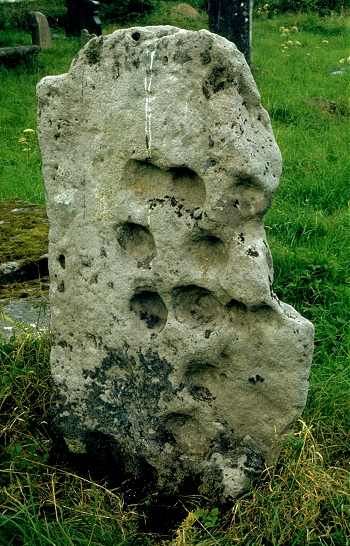
In the graveyard of a Protestant church (in Rockfield townland) on the W side of the road, a large slab, 1.5 metres high has at least 10 deep cup-marks on one face, while the other face has been Christianised with a Greek cross on a bifurcated stem.
Nearby is a small, broken phallic pillar and a perforated stone half-embedded in the ground. Near the graveyard wall is 'The Bishop's Stone' with an ecclesiastic on one side and a human face above interlace on the front edge. This site - like White Island and Boa Island farther north, with their carvings both 'pagan' and Christian in Christian contexts - is interesting for its very obvious overlap of 'pagan' and Christian. The cup-marked stone looks very much like a multiple- bullaun Christianised and set on edge: compare the site at Killinagh in county Cavan. Many standing-stones and ogam stones in Ireland were latterly Christianised, as were some menhirs in France. Fermanagh and Leitrim were of course, until the last subjugation by the English, the most inaccessible and culturally conservative part of Ireland. Both counties even today have a kind of remote or otherworldly feeling to them. ~ 14.5 km NW are the Boa Island statues.
Reyfad: Petroglyphs (rock art)
Approached by a motorable track up to a modern bungalow. 500 metres WNW of Boho graveyard (which has a fine 12th century cross-shaft featuring Adam and Eve and the serpent on its E face), are 6 stones in a field in front of the bungalow, five of which have cup-and-ring carvings. The largest of them, 3.3 metres long and over 2 metres high, is almost completely covered with the designs, many of them overlapping. On another, smaller, stoine, the cuyps and rings are unusually deep. The engravings are partly obscured by heavy growths of lichen, and are best seen in oblique light on a fine summer evening. |