
|
county list
|
Tell-A-Friend
| Court-tombs = Portal-tombs = Wedge-tombs = Passage-tombs = Stone Circles | France | |
|
Tell-A-Friend |
|
SELECTED MONUMENTS IN
Place-names in italics refer to listed entries.
Dowth: Passage-tombs and souterrain
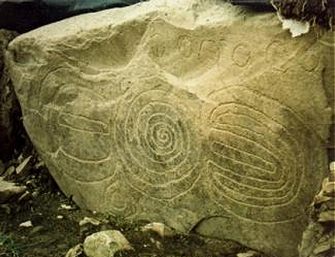
Of the three principal tombs of the Bend-of-the-Boyne passage-tomb cemetery or necropolis, this is the earliest and the only one (so far) not to be ransacked, vandalised and travestied by modern archæologists. It was partly excavated in 1847 though it had been pillaged (by Vikings and earlier looters) long before that. The cairn or tumulus is about 90 metres in diameter and 15 metres high. Three stone-lined passages lead into the mound from the W : one to a cruciform passage-tomb chamber, one to a circular passage-tomb chamber, and the third to a much later souterrain or refuge. When I was last there, the cruciform tomb was reached by climbing down a ladder in an iron cage, and crawling about over loose stones. The long passage is crossed by 3 sill-stones. This tomb is - in all senses - less developed than the neighbouring and preceding tourist-attractions of Newgrange and Knowth, partly because the chamber is much lower, and partly because the decoration is much poorer. The chamber is lintelled rather than corbelled, and on the floor stands a single stone basin - somewhat the worse for wear after 5,000 years. The right-hand arm of the chamber leads into another long rectangular chamber with 2 subsidiaries: an L-shaped extension entered over a low sill. This may be the earliest part of the tomb, later brought within the design of the cruciform tomb. It is floored with a 2.4 metre long flagstone containing an oval bullaun (artificial depression). Several of the orthostats of passage and chamber are decorated with spirals, chevrons, lozenges and rayed circles. Rayed circles or suns can also be seen
on one of the decorated kerbstones of the tumulus. A kerbstone with cup-marks, a spiral and a flower-like design marks the entrance to the second, smaller tomb - with modern concrete roof. Quartz was found fallen outside the kerbing, showing that the entrance to this tomb was surrounding by glittering white, as at Newgrange. This tomb has a few decorated stones, and a single, massive right-hand recess. At the entrance to the passage of the cruciform tomb is an early mediæval souterrain. Access: Not known: probably forbidden.
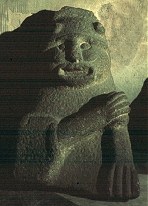
3.2 km WNW of the village of (The) Naul, along a short track leading from a by-road, a notice is displayed stating where the key can be obtained. A fine cruciform tomb, excavated, and now preserved under a concrete shell dome grassed over, is imaginatively lit by slits above the decorated lintels of the three recesses. It is quite in contrast to the Disneyfication that has occurred at Newgrange. The original tomb was probably roofed with timber and sods. There are 12 fine decorated stones: one upright one has a stylised human face.
click on the thumbnail for larger pictures
~ 16.5 km NNE at Baltray (O 145 772), W of a track leading N out of the hamlet of Baltray, are two otherwise unremarkable standing-stones which, it has recently been revealed, align significantly with the Fourknocks tomb.
Loughcrew: Passage-tomb complex
Occupying the two Loughcrew Hills of Carnbane East and Carnbane West in Slieve na Calliagh
(Sliabh na Caillighe)
, with car-parks at the saddle between the hills, are several passage-tombs, some of which are usually locked:
see notices for where keys may be obtained
. There were originally between 50 and 100 cairns or tumuli in this prominently-sited necropolis, but the usual Western European destruction and neglect of prehistoric monuments (from earliest times) has greatly reduced the number. Those which are locked have fine decoration, as well as one or two small, unroofed tombs. Carnbane East is the hill also known as
Sliabh na Callighe
, or the Hag's Mountain: the tumuli were said to have dropped from the Earth Mother's apron.
click on the thumbnail for a larger picture
is also surrounded by 6 satellites with a variety of decoration in them, including solar designs. On Carnbane West, there are 2 large cairns, one apparently empty, but the other (cairn L) containing a fine decorated tomb with 5 side-chambers and a limestone monolith of 'ritual significance',
click on the thumbnail for larger pictures
surrounded by 7 smaller roofless tombs, some with decoration, and some with their short passages (mostly facing E) still partly roofed. A sunny early-morning summer visit is recommended to see the engravings well.
These tombs represent an intermediate stage in the development of elaborate tombs between the skyline cairns of
Carrowkeel
in Sligo, and the lowland complexes the E of county Meath.
~About 700 metres to the E of Carnbane East, on Patrickstown Hill, are the less-accessible remains of 4 more tombs, out of a former 25 or so. ~ On King's Mountain, 3.2 km to the E, a former roofstone now stands upright on the site of a destroyed tomb. Half of one face is covered with well-executed spirals and arcs. ~ 800 metres E of Carnbane East, 300 metres W of a by-road in Ballinvally are the remains of a stone circle. Four large stones up to 2 metres high still stand, together with several fallen and broken ones. One of those still standing has beautiful natural channels in it. Five or six stones extend in a row N of the circle for a distance of 800 metres, and there are several small isolated standing-stones scattered about the surrounding area. A stone with fine petroglyphs from the same townland is in Dublin's National Museum of Ireland.
Newgrange: Passage-tomb and Stone circle
Open daily, with guided tours in summer, this remarkable tomb has been degraded by "restoration" and by its status as one of Ireland's top three tourist attractions and the only prehistoric tomb that most visitors to - and natives of - Ireland can be bothered to see. Under the pressure of coachloads, the casually curious, and the faintly-inquisitive, not to mention the fatuously over-restored façade, it has lost all its atmosphere. To this extent it is in a far worse state than Stonehenge. Books and photographs "explaining" it can be bought on site - and there are many websites doing much the same for it and other passage-tombs, which seem to catch the space age
Zeitgeist
more than other prehistoric tombs.
It is hard to appreciate the fine circle surrounding the mound of Newgrange, because of the razmatazz of the pseudo-authentic entrance to the tomb, the visitor centre, the guides, the buses, the ticket-booth and all those things that cheapen the place for the brief bemusement of gawpers who mostly know little about Ireland and less about prehistoric Europe - and go away knowing very little more. The circle was erected after the tomb was built, apparently by late-Neolithic "Beaker-people" from Northern Britain, who also built a smaller circle at Ballynoe in county Down. Twelve out of an original 35 large stones survive.
click the thumbnail for larger pictures
The reason for the building of the circle was perhaps to incorporate it into a new form of sanctity, as old churches in Ireland were taken over from the Celtic rite first by the Roman orthodoxy, then later by the Anglicans. There are also satellite-tombs, many of which have also been excavated. ~ Slightly over 1 km NW of Newgrange is the even more complex, marvellous and even more pillaged tomb of Knowth , with several decorated kerbstones,
and also with satellite tombs. It is due to be sold to mass-tourism in the same way as Newgrange - and if there are disquieting reports of the manufacturing and/or altering of archæological evidence the better, there is a strong tradition of such practices in Ireland. By the time the passage-tomb-building societies had extended their activities and influence from Sligo, via the skyline-necropolises of Carrowkeel and Loughcrew, as far as the Bend of the Boyne - where (apart from the absence of dominating heights) the land and landscape resembled the Sacred Plateau of Carrowmore and environs - they had become obsessed, like the Babylonians whose systems we still use, with astronomy and astrology, and obviously were a plutocratic, totalitarian hierocracy.
Tara: Passage-tomb and
phallic pillar
Before the commercialisation of Newgrange to a kind of pseudo-Neolithic Mall, this was the most celebrated (and very disappointing) of Irish sites. The earthworks are of Iron Age date but are not the remains of banqueting halls etc. that Romantic songs might lead us to expect. The two most interesting things are the remarkable Stone of Destiny ( Lía Fáil : Ireland's romantic answer to Scotland's "Stone of Scone") - a very phallic granite pillar some 1.5 metres high, moved here to commemorate the dead killed in a skirmish during the ill-fated 1798 Rebellion. Unfortunately it is close to a cheap, modern statue of St Patrick even more hideous than the usual: "an offence alike to Tara and the National Apostle". The simple conjunction of these two monuments says as much about the Irish character as the works of James Joyce. The Lía Fáil was moved from its position as significant standing-stone near "The Mound of the Hostages", which is in fact a small passage-less passage-tomb, whose entrance is covered with a grille.
Its walls are composed of just 7 massive orthostats, one of which is decorated, and only half of the chamber is roofed: with 2 massive capstones. |