French Genius
  home =   free book   =   reviews   =   feedback =   about us  

from Drakestown, county Meath


irish genius pages

DISSIDENT EDITIONS
POETRY

poems of the month

rejoice in the dog

post-millennium maggot

dispatches from the war against the world


albanian poems

french poems in honour of jean genet

the hells
going on

suicide for
non-beginners

fearful symmetry

book disease

foreground
trouble

the transcendental hotel

cinema of the blind

lament of the earth mother

uranian poems

haikai by okami

haikai on the edge

black hole of your heart

jung's motel

leda and the swan

confession from belgrade

gloss on rilke

jewels in shit: poems by rimbaud

villon's dialogue with his heart

vasko popa:
a shepherd of wolves ?

imagepoem


BETWEEN POETRY AND PROSE

400
revolutionary maxims

nice men


DISSIDENT EDITIONS
ESSAYS

kamikaze and crusade

being or television

womb of half-fogged mirrors

overcoming tourism

anti-fairy tales

the dog of sinope

this sorry scheme of things

the bektashi dervishes


field guide
to megalithic ireland

houses for the dead:

court-tombs

portal-tombs

passage-tombs

wedge-tombs


stone circles

petroglyphs
(rock art)

standing-stones

ogam-stones &
cross-pillars

cross-pillars
& cross-slabs

sweathouses

ireland
& the phallic continuum

the earth-mother's
lamentation

satan in the groin
part two

east of brittany:
megaliths of western and southern france

génie
française

links


feedback


feedback

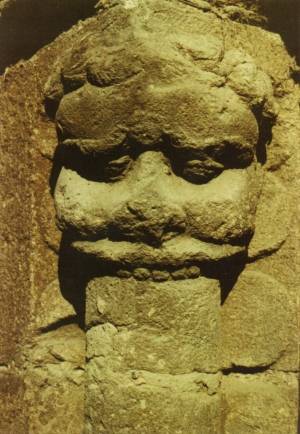
from Drakestown, county Meath

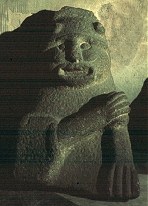
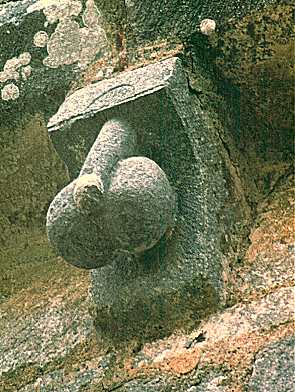
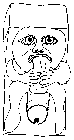
Romanesque 'mouth-puller' from Drakestown (county Meath), Ireland.


SATAN IN THE GROIN

Male exhibitionist carvings
on mediæval churches

part III


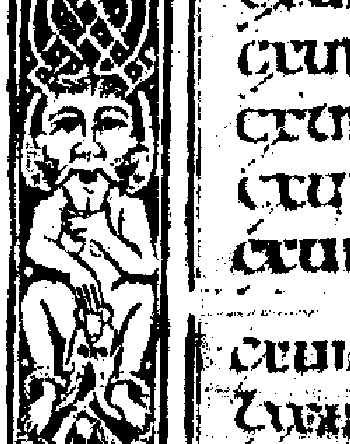
The earliest male exhibitionist in a Christian context occurs in an Anglo-Saxon manuscript
from the 8th century.


Vatican MS Barberini, Lat.570, detail

A monk points to his genitals which are being bitten by snakes which represent both the temptation and the hellish punishment for yielding to it. Snakes also attack his hair and his moustaches while he pulls his beard - his secondary sexual characteristics. The motif of a human being threatened or punished by beasts or monsters, frequent in Romanesque art, also occurs on Irish sculptured crosses .

Four centuries later, a Spanish carving depicts a bicorporeal man each of whose bodies tugs at his beard. This is close to the motif of mutual beard-pullers, symbolising perhaps 'unnatural' affection .


Sant Joan de les Abadesses (Girona), Spain


Slightly earlier than the Anglo-Saxon manuscript, the Book of Kells shows a warrior with spear displaying his virility - but as a vignette, without any evident censure.

detail of folio 200r

Also from Ireland, though carved in the 12th century is a remarkable grotesque from a Round Tower, showing a contorted figure with huge and very Norse-Irish head displaying buttocks and what can be interpreted either as dangling labia or scrotum - most likely the latter.
Two monsters bite its outstretched arms.


Berrymount (Cavan), Ireland

There is no end to the variety and variations of the male exhibitionist motif. As we have seen in two of the four Romanesque churches in Poitiers, they are not necessarily grotesque. This Czech figure would almost qualify for inclusion in a gay magazine.

Capital in Chapel-Palatine, Cheb (Bohemia), Czech Republic.


Devils, of course, are often depicted with huge genitals - propaganda which might well have been counter-productive.

Two views of a high frieze at Villers-Saint-Paul (Oise), France:
the devil at the bottom is carrying a phallic money-bag.


A more positive meaning is attached to male exhibitionism on a remarkable corbel which shows a clothed couple embracing, each with a halo, and the woman's left hand feeling for size or hardness the man's penis which pokes out from underneath his tunic.

Maillezais (Deux-Sèvres), France

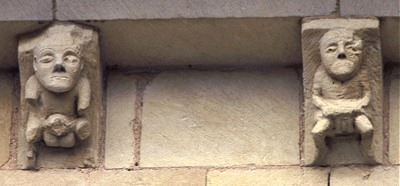
If it is not a depiction of the early Christian 'sacred marriage' of two holy males in Brotherly Love, this could refer to St Augustine's only justification for the sexual union and marriage of Christians: in order for two saved souls to create another soul that is likely to be saved. Compare this with the usual depiction of pairs or couples (and note that the male has been smashed, probably by post-mediæval re-roofers: during modern re-roofing the corbel-table was cleaned):


Manéglise (Seine-Maritime), France


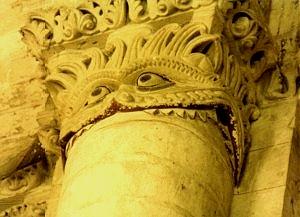
The meaning of the rare motif of the column-swallower
can only be guessed at,

Capital of nave, Cunault (Maine-et-Loire), France

but it is possibly connected with our theme. Its earliest appearance is also in an Anglo-Saxon manuscript.

Door-capital, Puente la Reina (Navarra), Spain


Exhibitionists rarely appear on capitals, and column-swallowers (for obvious reasons) never appear on corbels. One fine example extends a hand into its pig-like ear.

Door-capital, Saint-Romans-lès-Melle (Deux-Sèvres), France

Capital in Cormac's Chapel, Cashel, (Tipperary), Ireland

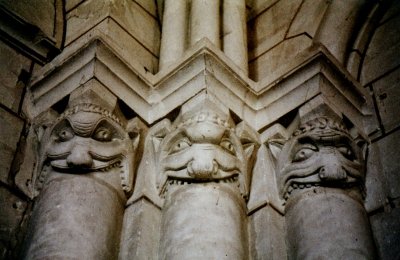
Magnificent triple capital, Lucheux (Somme), France


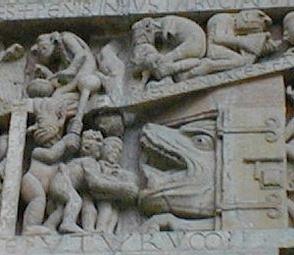
The unequivocal sin of Sodomy is also a rare subject: I know of only two examples. One is on the celebrated Last Judgement tympanum of the Pilgrimage church of Conques, where a devil with a club sodomises a sodomite into the beastly jaws of Hell.


Conques (Aveyron), France

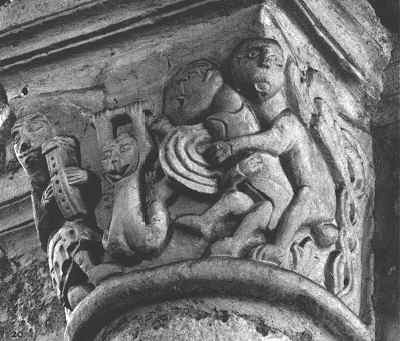
On the other, the sodomy is portrayed as occurring in the daily lives of travelling entertainers, anathematised by the mediæval Church.

La Chaize-le-Vicomte (Vendée), France

Slightly less rare is the motif of disembodied male organs, indicating a warning against rather than celebration of sexuality.

Corbel, Sainte-Colombe (Charente), France

A little less rare is the variant of the very common 'tonguesticker' whose tongue is long enough to reach his genitals; this motif is not quite the same as the genital-licker or -sucker illustrated on the previous page. The example at Mere in England combines several sinful motifs: the acrobat, the anal exhibitionist, the monster - and possibly even the vagina dentata, a feature of some Irish female exhibitionists.

Interior corbel at Mere (Wiltshire)
photo by John Harding

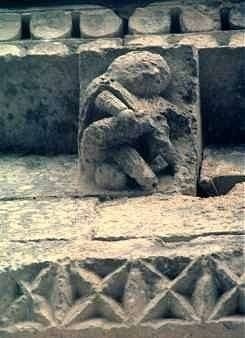
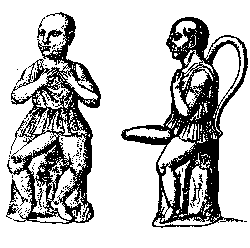
Less rare again is the ithyphallic spinarius or thornpuller, attempting to extract St Paul's "thorn in the flesh" generally thought to be sexual desire. These are inspired by (but bear little resemblance to) a Roman statue of a naked athlete notorious in mediæval times.

Saint-Léger-en-Pons (Charente), France


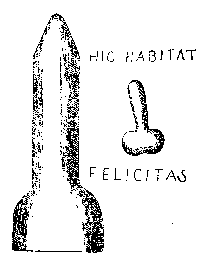
By contrast, here are three clay vessels from Roman times which are completely different both in function and mess

age...
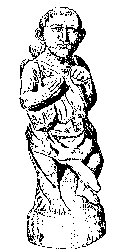


and Roman images in stone which proclaim a piety
which monotheisms have never tolerated
...
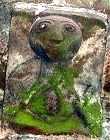
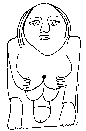
...and one of many phallic statues which were widespread in pre-Christian Europe - this one from a remote island in a remote lake in Ireland.


Male side of back-to back double figure, Caldragh graveyard,
county Fermanagh.


Anti-copyright Anthony Weir, June 2000
 

The pictures and text on these pages are condensed from a Book in Progress ( 'The Silent Orgy ') which has not so far found a publisher with the means to print and distribute it.

search this site
e.g. by typing a place-name or subject


This page is included on the


inspired by this Website.


BACK TO PART ONE


Tell-A-Friend


Click here for a related essay:

POTENCY AND SIN :
IRELAND AND THE PHALLIC CONTINUUM


Irish Genius


This Sheela-na-gig Webring site
is owned by
anthony weir

Powered by RingSurf !


Dissident Editions